

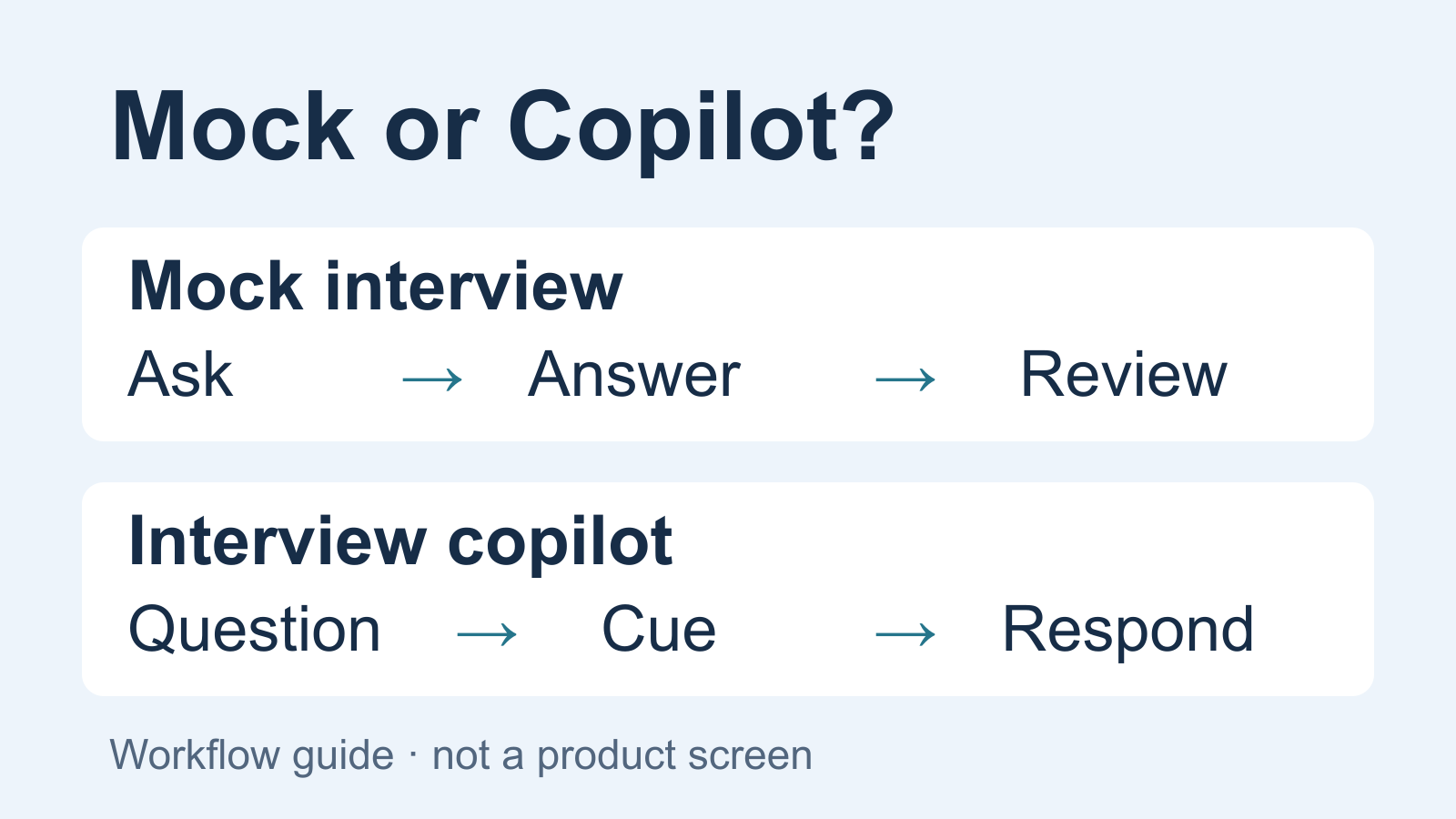
Choose an AI mock interview when you need someone to ask questions, hear your own answer, and identify what to practice next. Choose an AI interview copilot when you want suggestions while another person is asking questions in a permitted session. The distinction is the job you need done: rehearsal and feedback, or guidance during a conversation. One product can offer both.
If you cannot yet explain a project without help, start with rehearsal. If you already know your examples and want to evaluate how suggestions fit into a conversation, try a copilot in a private practice session first.
Evidence scope: This guide combines official documentation checked on October 12, 2026, a short Verve AI Mock session on October 13, and a SkillCopilotAI response photographed by a user on October 13. All candidate and company details are fictional practice material. This is a workflow demonstration, not a controlled performance comparison. SkillCopilotAI publishes this guide and sells an interview copilot; Verve AI and Final Round AI are competing vendors.
What changes between the two workflows?
In a mock interview, the AI usually takes the interviewer or coach role. You answer, then use feedback to decide what to change. In a copilot session, the interviewer may be a practice partner; the AI helps you respond to their question. Whether feedback arrives during or after the session depends on the product.
| Question | AI mock interview | AI interview copilot |
|---|---|---|
| Who asks the questions? | An AI interviewer, or a prepared question sequence | Another person or an external question source |
| When is it useful? | Before an assessed interview, in repeatable rehearsals | During a practice conversation or explicitly permitted assisted session |
| What do you provide? | Target role, questions, background and your own answers | The incoming question and relevant background; some tools also accept screen input |
| What do you receive? | Follow-ups, critique, a debrief or practice targets, depending on the tool | Suggested talking points, answer text or technical guidance |
| What should you inspect? | Whether feedback identifies something specific you can fix | Whether the suggestion is truthful, relevant and usable while listening |
| What setup matters? | Text or voice input, recording and review options | The actual audio source, permissions, display and meeting setup |
| What are the limits? | A practice score is not an employer's hiring judgment | A generated answer can miss context or invent details; live use still requires permission |
These are typical roles, not a universal feature specification. Check the specific mode you intend to use rather than relying on a product's name.
Final Round AI's Practice Interview page describes an AI-led rehearsal tied to role materials, followed by a debrief and areas to re-drill. Its Interview CoPilot page describes suggestions based on the question, resume and job context, alongside practice and debrief features. The two pages illustrate why “mock” and “copilot” need not mean separate subscriptions or separate products. They do not establish how well either mode performs.
Our SkillCopilotAI product page describes question capture, resume and role context, and guidance in a desktop overlay. The user-supplied example below shows one suggested answer and its factual limits. It does not verify response latency, audio reliability or screen-sharing behavior.
The same question, used two ways
The background is fictional; the product questions and outputs below are real observed material. Keeping those two things separate lets us inspect whether a tool uses the supplied facts or adds details that were never provided.
In the Verve session, the AI interviewer asked:
Can you walk us through your role on the internal support-ticket search pilot at Fictional Practice Company, and what your specific personal contribution was?
Here is the fictional candidate's fact sheet:
- Alex was a backend engineer on a four-person team building an internal support-ticket search tool.
- A teammate proposed adding a separate search service before the pilot.
- Alex proposed starting with PostgreSQL full-text search to keep the pilot within a two-week delivery window.
- Alex compared both options using 30 synthetic search queries and shared the limitations with the team.
- The team chose PostgreSQL for the pilot and recorded conditions for revisiting the decision.
- The pilot shipped within two weeks. There is no measured customer impact, production latency figure or revenue result in the fact sheet.
What was actually tested?
On October 13, 2026, Codex operated a logged-in Verve AI account in the Chrome profile named cand on Windows. A user uploaded the fictional resume and later confirmed reading a prepared response aloud. The session used Behavioral Questions, the fictional Backend Software Engineer profile, English and the Balanced pause setting. It lasted roughly four minutes, rather than a complete 30-minute rehearsal.
For SkillCopilotAI, the user operated the Windows desktop application they identified as CSAI.exe and supplied two screen photographs showing the same question and the suggested answer. Codex reviewed the photographs; it did not operate that desktop application. The photos do not establish the exact background configuration, input method, model or application version. Neither product's exact model or app version was independently confirmed. This was one limited example, with no repeated trials or latency measurement.
Verve AI Mock: ask, respond, then review
The Verve AI Mock interface required a question type and an Interview Profile containing a resume, company information, position and job description. In this account, the launch screen showed a 30-minute limit and five remaining sessions. Those were the account's visible allowances at the time, not a general claim about every plan.
The first substantive question referred to the support-ticket search pilot and asked for personal contribution. The candidate transcript then contained only:
I'm not sure.
After Next Question was selected, the interviewer rephrased the request:
That's okay, it can be hard to jump right in. Could you describe your general responsibilities on the support-ticket search pilot, even at a high level, and one thing you personally built or decided?
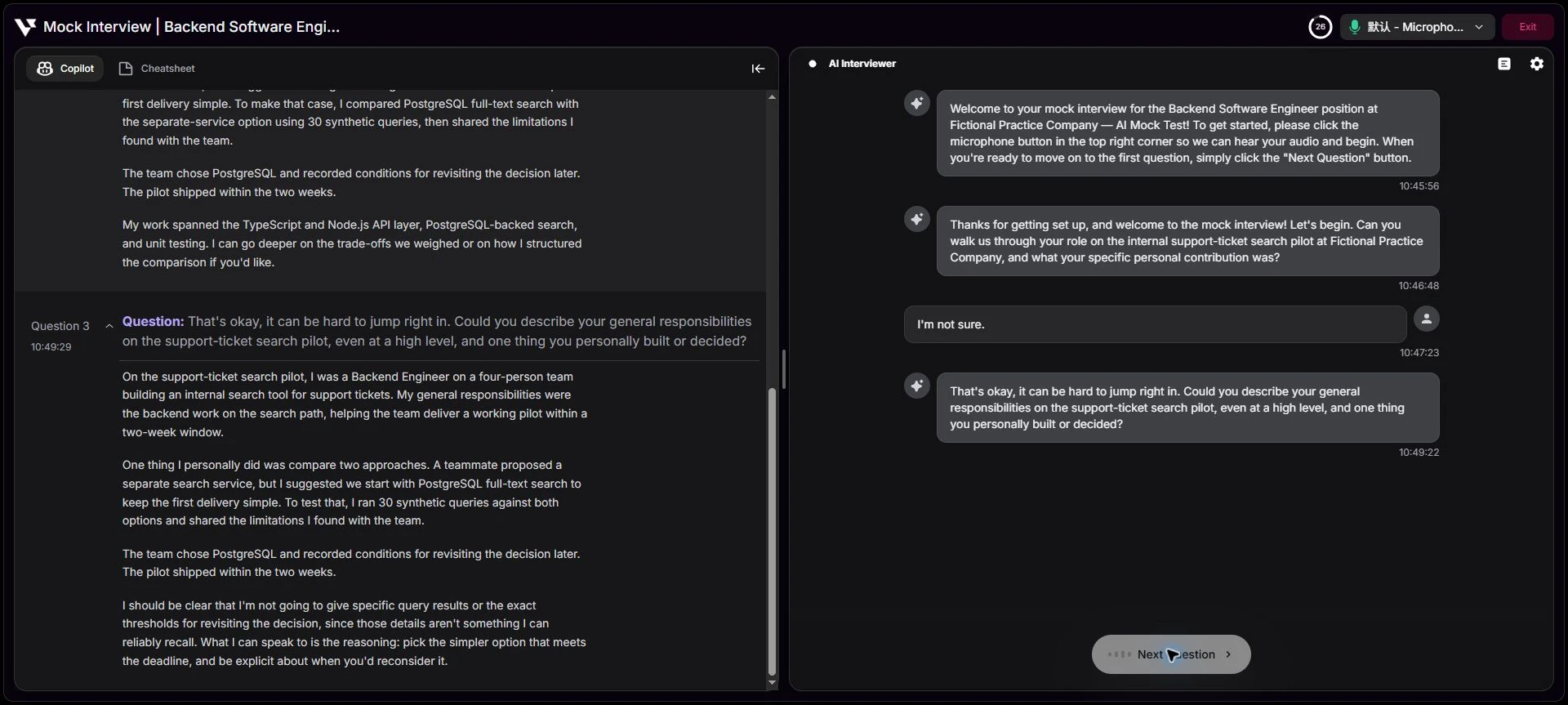
Actual Verve session, October 13, 2026. The left panel contains AI suggestions; the right panel contains interviewer messages and captured candidate speech. A suggested answer is not evidence that the candidate said it.
Open the full-size session screenshot.
The user confirmed reading a longer prepared answer, but that answer did not appear in the session or report transcript. The source of the short “I'm not sure” transcription was not independently confirmed either. Without a recording and verified audio input, this cannot establish why the longer answer was missing or measure transcription accuracy.
Ending the session produced a report with feedback and a transcript. The captured report showed 1.7/10, but explicitly said there was insufficient data for a meaningful evaluation. It recommended preparing a project story and rehearsing a structured answer.
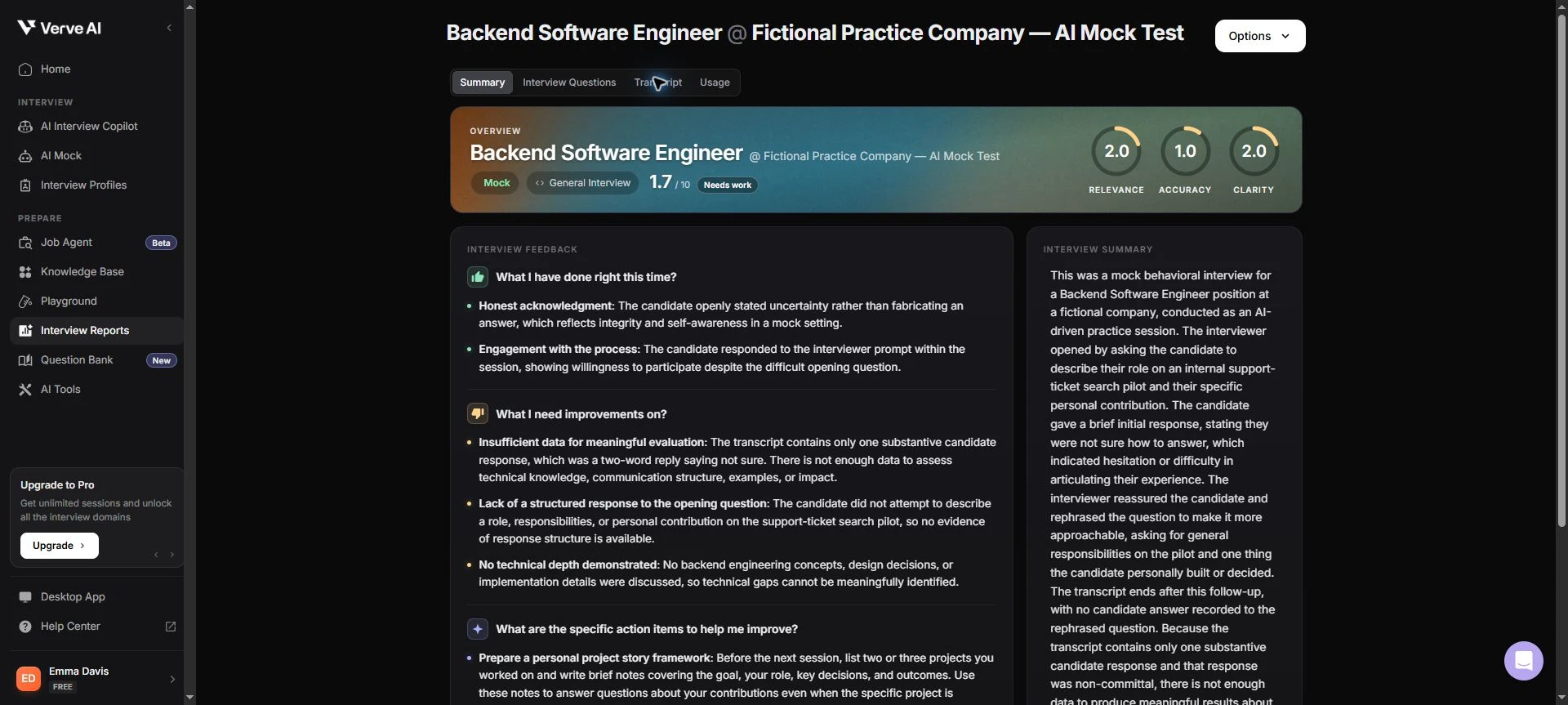
Actual report for this incomplete-input session. The score concerns the sparse captured transcript, not the longer prepared answer, the user's ability or the quality of Verve as a product.
Open the full-size report screenshot.
This demonstrates the rehearsal loop: the tool asks, receives whatever speech is captured, follows up and produces review material. Before using the feedback, check that the transcript contains the answer you actually gave. Our seven-day AI mock interview practice guide explains how to turn a reliable recording or transcript into the next exercise.
SkillCopilotAI: generate guidance for the same question
The user's photographs show the project question followed by an AI answer organized under “My Role on the Support-Ticket Search Pilot,” “My Personal Contribution,” and “The Decision and Outcome.” One passage reads:
I ran a comparative analysis using 30 synthetic queries to test both approaches.
The answer also refers to PostgreSQL, the separate search service, the two-week delivery window and the team's decision. Those details match the supplied fictional fact sheet.
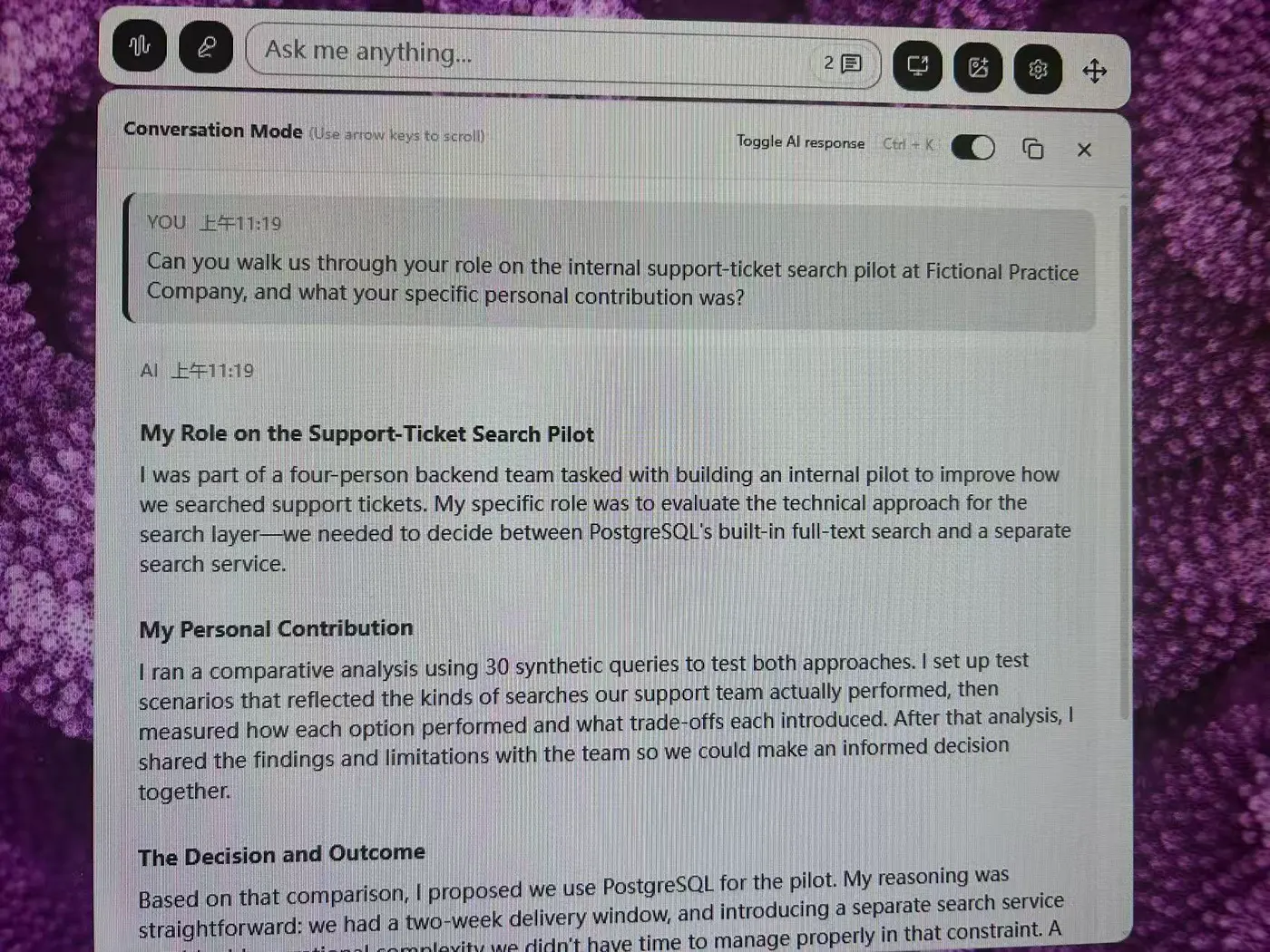
User-operated SkillCopilotAI, photographed October 13, 2026. This is a real screen photo, not generated artwork or an editor-operated desktop test. The original candidate and company background is fictional.
Open the full-size question and answer photo.
A relevant answer still needs a fact check. The response goes beyond the supplied background in several places:
| Generated detail | What the fact sheet actually supports | What to do before using it |
|---|---|---|
| Test scenarios reflected searches the support team actually performed | Alex used 30 synthetic queries; their design and relationship to actual searches were not supplied | Confirm the query source or remove the claim |
| The team lacked time to manage the operational complexity of another service | A two-week deadline and a proposal to keep the pilot simple | Treat this as a possible explanation, not an established personal recollection |
| Usage changes or performance bottlenecks would trigger a review | The team recorded conditions, but the actual conditions were not supplied | State the real conditions instead of adopting plausible ones |
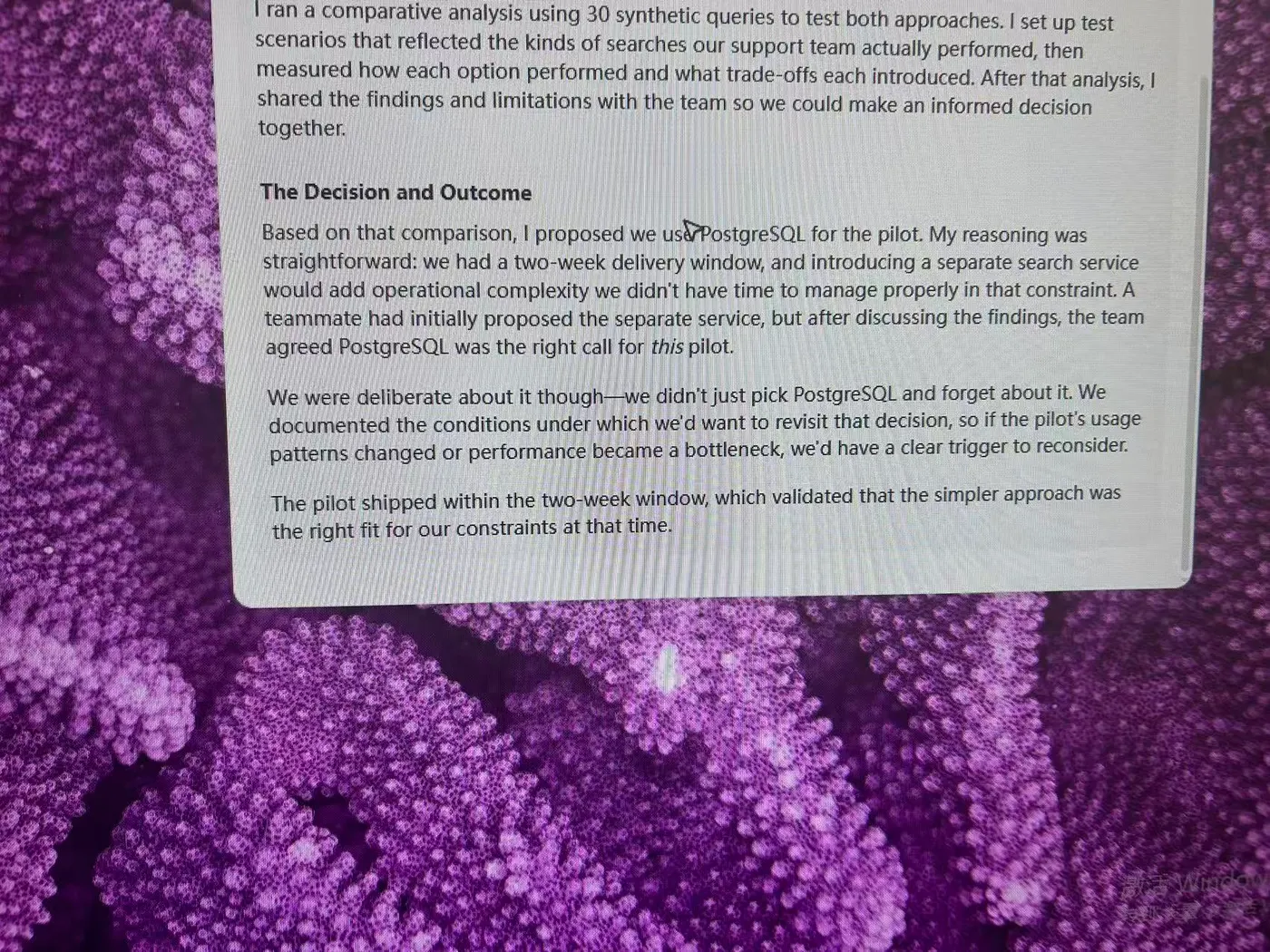
Continuation of the same user-supplied response. Plausible explanations can still add facts that were absent from the input.
Open the full-size outcome photo.
The closing claim that shipping on time “validated” the simpler approach also needs qualification. On-time delivery supports meeting the schedule; it does not independently establish performance or long-term suitability. The visible response did not add revenue, user-count or latency numbers, but that alone does not make every sentence factual.
The useful output here is a structure and a starting draft. Before speaking it, verify the details and reduce it to facts you can explain under follow-up questions. A suggested response does not show that the candidate can deliver or defend it unaided.
One product can contain both workflows
The Verve session also exposed a Copilot side panel with generated suggestions, even though Enable Assistance was off at launch. That is an observation from this session, not a conclusion that the setting is broken or that every session behaves the same way. It reinforces the main selection rule: inspect what a mode actually does instead of assuming “Mock” and “Copilot” are mutually exclusive products.
These examples establish workflow differences, not an answer-quality ranking. Verve did not capture the complete spoken response, and the SkillCopilotAI photos do not document all settings. Comparing the report score with the polished suggestion would compare different kinds of evidence.
Choose according to the gap you need to close
You do not have a suitable story yet
Start with preparation and a mock session. List what you actually did, which decision you owned and what result you can support. Ask follow-up questions that expose missing details. Neither kind of tool can create a truthful experience you have not had.
You have the facts but ramble
Use short rehearsals with a time limit and a saved transcript or recording. Check whether you stated the decision, your contribution and the outcome. Repeat without the generated script. A copilot cue may suggest a structure, but evaluating your delivery requires hearing your answer.
You struggle when a technical constraint changes
Practice follow-ups rather than memorizing a first solution. Ask what changes if memory is limited, writes increase or the deployment environment differs. Explain your own revised approach before requesting critique. If you also evaluate copilot suggestions, check them against every new constraint and run any proposed code yourself.
You want guidance during an allowed conversation
Evaluate a copilot in a mock call using the same computer, audio source and language you plan to use. Check whether it captures the complete question and whether you can follow the conversation while consulting suggestions. A feature list cannot settle these questions.
For an assessed interview, follow the employer's instructions and obtain explicit permission for assistance. A product's ability to hide a window does not establish permission. Our guide to AI listening and answer suggestions explains the input and context limitations in more detail.
A selection sheet you can fill in
Copy this before trying a tool. A blank is useful: it identifies something to check rather than assuming the product supports it.
| Your requirement | Your answer or evidence |
|---|---|
| The gap I want to fix | Missing examples / unclear delivery / technical follow-ups / conversational guidance |
| The session I will use | Solo rehearsal / partner mock / explicitly permitted assisted interview |
| Input I need | Typed questions / microphone / system audio / visible coding prompt |
| Background I can safely share | A redacted summary of my role, contribution, constraints and results |
| Data handling I need to verify | Whether audio and background are retained, used for training, or removable; check the current policy and account controls |
| Practice material I want to keep | My answer, critique, revised attempt and next practice target |
| Device and language | Exact OS, audio setup and speaking language to verify |
| Evidence that would make the tool useful | One specific error it identifies or one relevant cue I can verify |
| Reason to stop | Invented experience, missed constraints, unusable input or interference with listening |
Check access to the mode you need before paying. Creating an account or uploading a resume does not necessarily include a practice or live session. This article does not compare prices or trial allowances.
Can you use both without losing the value of practice?
Yes. Keep an unaided attempt separate from an assisted one:
- Answer a question without suggestions and save the recording or transcript.
- Review the factual gaps and structure. Correct the background using your real experience.
- If conversational guidance is relevant, use the same question in a partner mock with a copilot. Save that attempt separately.
- Close the suggestions and answer a fresh follow-up in your own words.
For Alex's fictional example, a follow-up could be: “What evidence would make you revisit PostgreSQL?” The fact sheet says the team recorded conditions but does not specify them. That absence should trigger preparation, not an invented threshold.
The purpose of the final unaided attempt is to check what you can now explain yourself. A more polished assisted answer alone does not prove learning or predict an interview outcome.
Questions the labels do not answer
Can a general chat assistant run a mock interview?
You can ask a conversational assistant to take the interviewer role, wait for your answers and challenge missing details. Whether it offers the voice input, saved feedback or session controls you need depends on that service. The ability to generate interview questions alone does not establish a reliable live audio workflow.
Does a high AI practice score mean you are ready?
Treat it as a prompt for inspection. Ask which sentence supports the score, whether your contribution is clear and which follow-up you still cannot answer. A tool's rubric may differ from the employer's expectations; it cannot certify a hiring result.
What should you try first?
If you are unsure, answer one relevant question without assistance and listen back. If you cannot find a truthful example or explain your decision, begin with mock practice. If the answer is sound and your remaining question concerns conversational guidance, evaluate a copilot in a permitted rehearsal. You can browse product research and comparisons after identifying that requirement.
Choose your next step
Compare tools or explore guidance for a permitted practice conversation.