


Yes. AI can listen to an interview question, turn the audio into text, combine that transcript with context, and generate a suggested answer. That is technically feasible today. But “possible” is not the same as accurate, permitted, private, or useful under interview pressure.
The safest use is before an interview: let AI ask questions, critique your own answers, and help you rehearse. During a real interview, use live assistance only when the interviewer or employer has clearly allowed it. Concealed assistance can violate the rules of the interview, expose a private conversation to another service, and leave you reading an answer that is late, generic, or wrong.
Key Takeaways
- A live assistant usually connects four stages: audio capture, transcription, context assembly, and answer generation.
- Transcription errors and missing context can produce a confident answer to the wrong question.
- Permission matters. Recording and processing another person's voice may raise legal, privacy, and employer-policy issues.
- Some assessment platforms monitor tab changes, screens, cameras, or unauthorized tools when those controls are enabled.
- AI is most valuable as a practice partner that improves skills you can demonstrate independently.
What to Check Before Choosing a Real-Time AI Interview Assistant
Search results for this question often lead directly to product pages promising instant, personalized answers. Treat speed, accuracy, privacy, and screen-sharing claims as vendor claims until you verify them in a permitted mock interview. A useful comparison should answer all of these questions:
| Check | What to verify | Why it matters |
|---|---|---|
| Permission fit | Whether the employer allows AI, transcription, recording, or outside resources | A technically capable tool can still violate the interview rules |
| Audio path | Whether it uses microphone audio, system audio, a meeting bot, or uploaded recordings | Setup, consent, and reliability differ by capture method |
| End-to-end delay | Time from the end of a full question to a usable suggestion | A fast first token is not useful if the tool answers before hearing the constraint |
| Context control | Which resume, job-description, notes, and conversation data enter the prompt | Missing or stale context produces generic or incorrect answers |
| Answer quality | Performance on ambiguous follow-ups, factual questions, coding edge cases, and corrections | A polished response can still be wrong or impossible to defend |
| Privacy and deletion | Retention period, subprocessors, model-training policy, export, and deletion controls | Interview audio and documents can contain personal or confidential information |
| Failure plan | Whether you can continue naturally when transcription, networking, or generation fails | Dependence becomes visible when the tool stops or the interviewer changes direction |
Use the same checklist when reading a product review. Our research-based Parakeet AI review and Cluely AI review separate published capabilities from permission, privacy, and independent-performance questions. Neither review substitutes for testing the current product and rules that apply to your interview.
How an AI Listening Assistant Works
The basic pipeline is straightforward:
- Capture the audio. The application receives microphone, system-audio, or meeting audio, depending on the device and permissions.
- Transcribe the question. Speech recognition converts the audio into text. For example, the current OpenAI Audio API reference documents an audio transcription endpoint. That establishes technical feasibility; it does not guarantee a correct transcript in every interview.
- Add context. The application may combine the transcript with a resume summary, job description, selected notes, or earlier conversation turns.
- Generate a suggestion. A language model drafts talking points, code, or a possible response.
- Display the result. The candidate sees the output as text while the conversation continues.
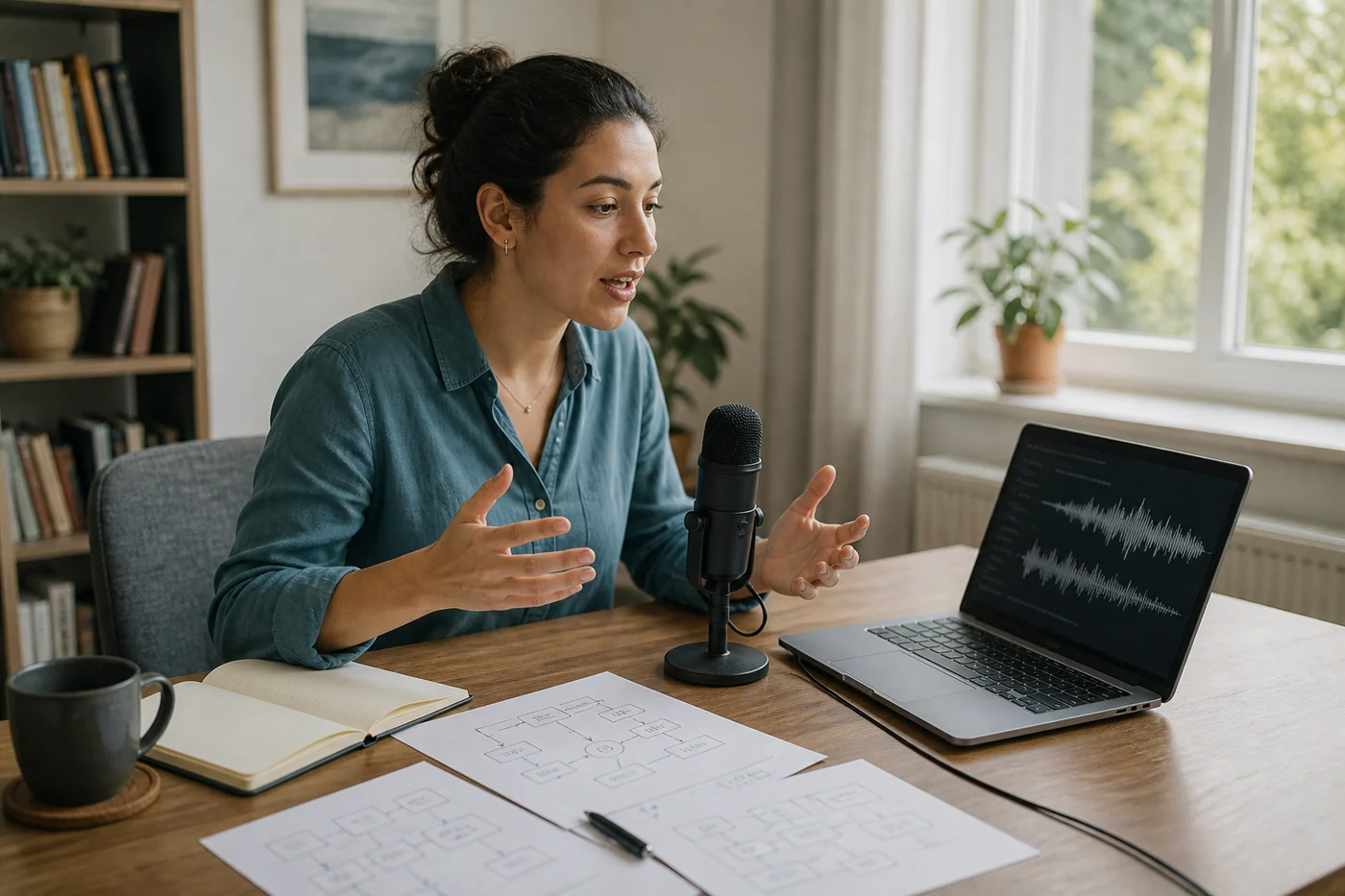
AI-generated illustration.
Every stage can add delay or error. A clipped sentence may lose a constraint. A product name can be transcribed as an ordinary word. A system-design question may depend on a diagram the listening tool cannot see. Even a perfect transcript does not supply the candidate's real experience, the interviewer's hidden evaluation criteria, or the judgment needed to choose among several defensible answers.
That is why an AI that listens and gives answers should be treated as a suggestion engine, not an authority.
What It Can and Cannot Do Reliably
A live assistant can be useful for relatively bounded tasks. It may identify the type of question, suggest a structure, remind you of a framework, or surface a follow-up you should address. In a permitted accommodation or an open-resource interview, that can reduce the effort of organizing information.
It is much weaker when the answer depends on facts only you know. Consider “Tell me about a time you changed a stakeholder's mind.” A model can propose a polished STAR outline, but it cannot know which parts are true. If it invents a result, changes who made a decision, or adds a metric, the answer no longer represents your experience.
Technical questions introduce similar problems:
- The tool may answer before hearing the complete constraint.
- It may choose a common solution that does not fit the interviewer's version of the problem.
- Generated code may compile but fail on an edge case.
- A plausible system design may ignore scale, consistency, security, or operational constraints.
- Reading a suggestion can divide attention when you should be listening and clarifying.
NIST's Generative AI Profile and AI Risk Management Framework identifies risks including confabulation, privacy harm, and over-reliance. In practical interview terms, verify every generated claim and never present an invented detail as your own experience.
Three Very Different Ways to Use It
The important distinction is not whether AI is involved. It is how, when, and with whose permission it is used.
1. Practice Before the Interview
This is the lowest-risk and usually the highest-learning option. Ask AI to run a mock interview, create follow-up questions, and compare two versions of your answer. Then close the tool and answer again from your own notes.
Our AI interview practice tools guide explains what to look for in a practice product. For a repeatable routine, use the seven-day AI mock interview plan.
2. Disclosed, Explicitly Permitted Live Assistance
Some interviews are intentionally open-resource. An employer may permit documentation, search, an AI assistant, or a specific accommodation. Ask before the session if the rules are unclear. A simple written confirmation is better than assuming that “open book” includes every external tool.
When live help is allowed, disclose the tool, minimize the information you send, and remain responsible for the answer. Explain the reasoning in your own words and be prepared to continue if the tool disappears.
3. Concealed Live Assistance
Hidden assistance has a different purpose: it makes the interview appear to measure independent performance when another system is generating part of the response. That creates a trust problem even if the answer happens to be correct. It can also prevent the interviewer from evaluating how you clarify ambiguity, recover from uncertainty, and reason aloud.

AI-generated illustration.
This guide does not explain how to hide a tool or bypass interview controls. If an employer has not allowed live assistance, prepare with AI beforehand and turn it off for the real session.
Compare the Options Before You Decide
Practice before the interview
- Permission: You control the practice session.
- Benefit: Repetition, feedback, and targeted study.
- Risk: Over-reliance on generic feedback.
- Default: Recommended when you verify the feedback and repeat unaided.
Live help explicitly allowed by the employer
- Permission: Clear approval with defined boundaries.
- Benefit: Organization, accessibility, or open-resource support.
- Risk: Privacy exposure, distraction, and incorrect suggestions.
- Default: Use only within the stated rules.
Concealed live answer generation
- Permission: Not disclosed or not permitted.
- Benefit: Immediate suggested wording.
- Risk: Integrity, privacy, weak skill signals, and wrong answers.
- Default: Not recommended.
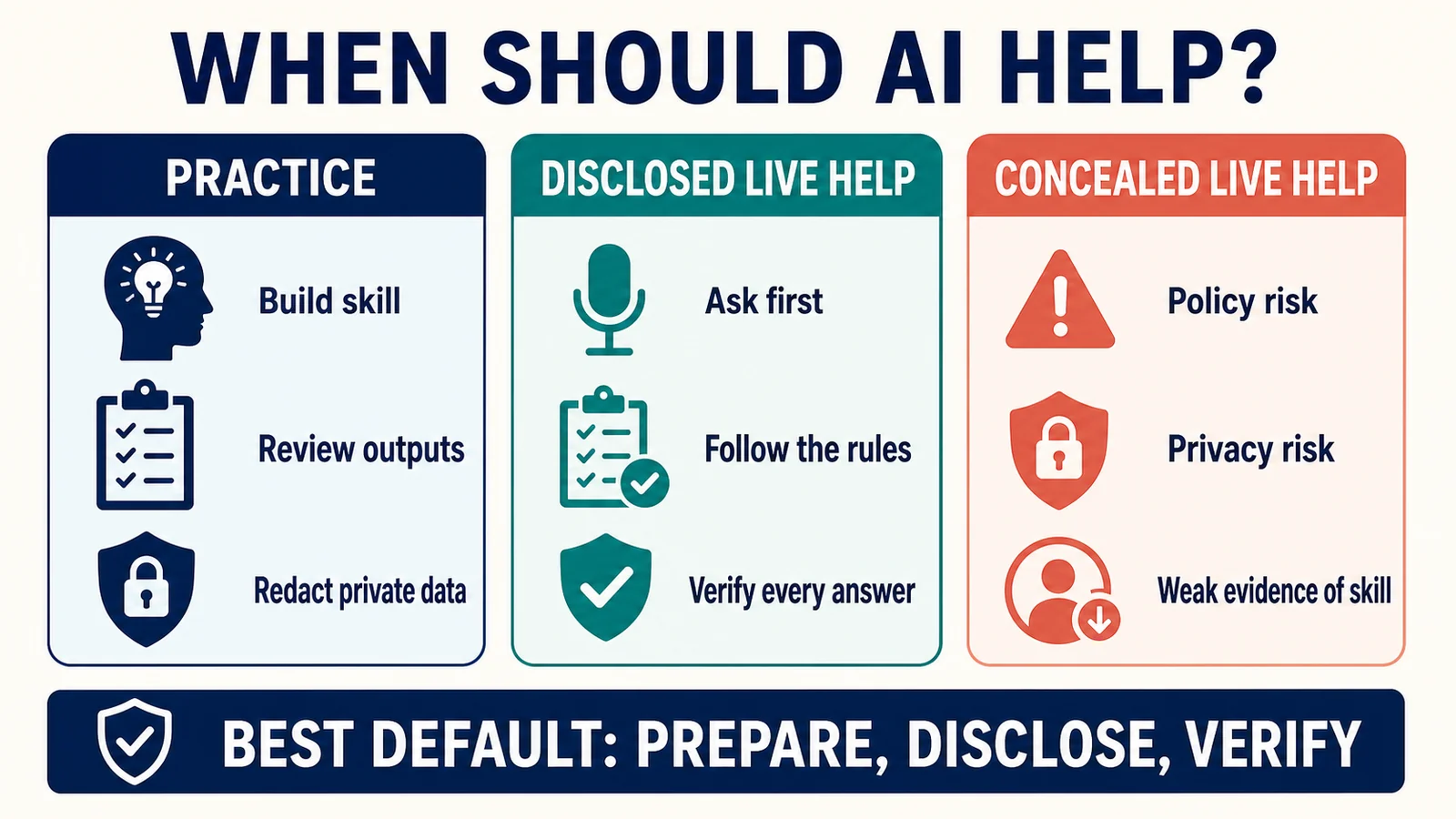
Original editorial comparison graphic.
If you are evaluating an interview-specific live assistant, our research-based Parakeet AI review applies the same permission, privacy, and reliability questions to a real product category.
Check Consent, Privacy, and Interview Rules
Recording and Consent
Listening software may capture or process another person's voice even when it does not save a traditional recording. The legal rules depend on jurisdiction, circumstances, and what the software actually does. In the United States, consent requirements can vary by state, and an interstate call may involve more than one state's rules. The Reporters Committee Recording Guide provides a state-by-state overview and cautions that its material is not a substitute for legal advice.
The practical default is simple: obtain clear permission before recording, transcribing, or sending an interview conversation to another service. If the interview involves another country, regulated work, or sensitive personal information, seek appropriate legal or compliance guidance rather than relying on a general article.
Data Privacy
An interview may reveal names, contact details, work history, unpublished products, customer information, or confidential technical context. Before using any assistant, check what data it receives, how long it keeps it, whether humans can review it, and whether the data may be used to improve models.
Use the minimum context necessary. Redact private identifiers and never upload employer secrets, customer data, private source code, or credentials. The same rule applies when using an AI interview assistant for practice.
Employer and Platform Rules
Rules vary by employer and interview stage. A recruiter conversation, a take-home exercise, a live coding interview, and a proctored assessment may all have different expectations.
As one platform-specific example, HackerRank's current Proctor Mode documentation says enabled tests can enforce full screen, monitor tab switching, request screen sharing, and analyze screenshots for unauthorized tools. That does not mean every HackerRank test uses every control, nor does it establish what all employers permit. Read the instructions for your actual assessment and ask the recruiter when they are ambiguous.
A Safer Way to Get AI Support
You can capture most of the value without bringing a hidden assistant into the interview.
- Create a small context brief. Summarize the role, seniority, five likely competencies, and your real projects without confidential details.
- Practice questions aloud. Do not merely read generated answers. Record your first attempt or keep a transcript.
- Ask for diagnostic feedback. Request missing context, unclear ownership, unsupported claims, weak tradeoffs, or absent edge cases.
- Rewrite from facts. Keep your real decisions and results. Remove invented metrics and polished phrases you would not naturally use.
- Repeat without the assistant. The second unaided answer is the real test of whether practice transferred into skill.
- Simulate interview constraints. Use a timer, unfamiliar follow-ups, and the same device setup you expect on the day.
- Confirm the rules. If you need an accommodation or want to use an external resource live, ask in advance and keep the response.
This workflow turns AI into a coach. The final answer still comes from knowledge and experience you can defend when the interviewer changes direction.
Research Method and Limitations
This is a Research-based guide, checked on August 31, 2026. We reviewed current public documentation for speech transcription, generative-AI risk management, U.S. recording-law summaries, and HackerRank's platform controls. We also reviewed the current search landscape to distinguish general educational guidance from vendor feature claims. We did not test a live answer product, evaluate a specific employer's policy, or provide legal advice.
Product behavior, assessment controls, employer rules, and laws can change. Confirm the current terms that apply to your interview, location, and tool before making a decision.
Frequently Asked Questions
Can you get AI to listen into an interview and help support you?
Technically, yes. AI can transcribe a question and suggest a response or structure. Use that capability for practice by default. During a real interview, use it only with clear permission and after reviewing privacy and consent requirements.
Is there an AI interview bot that listens to the questions?
Yes, products in this category advertise real-time transcription and answer suggestions. Feature availability does not prove that a tool is permitted in your interview or that its answers are correct. Compare products by permission fit, privacy, latency, transcript quality, and how easily you can verify the output.
Is an AI that listens and gives answers always recording the call?
Not necessarily in the everyday sense of saving an audio file, but it must receive or process audio to transcribe it. Processing, retention, and recording are not identical, and their legal or privacy treatment can differ. Check the product's current documentation and obtain consent where required.
Can I use AI in an open-book interview?
Do not assume so. “Open book” may mean personal notes or documentation, not an external answer generator. Ask which resources are allowed and whether you must disclose their use.
What if the AI gives me a wrong answer?
You remain responsible for what you say. Pause, clarify the question, verify assumptions, and explain your own reasoning. If you cannot defend a suggestion independently, do not present it as your answer.
Continue Preparing
Use AI to make practice more frequent and feedback more specific—not to replace the ability the interview is meant to evaluate. Start with the AI interview assistant, run a realistic mock session, and repeat your weakest answers without live prompts. If you want to test the supported SkillCopilotAI workflow on your own device, review the current downloads before the session and keep the tool off during any interview that has not explicitly allowed it.
The best support is the kind that leaves you more capable when the tool is gone.
Continue preparing
Editor selected
Best AI Interview Practice Tools 2026: How to Choose and Use Them Ethically
Compare AI interview practice tools in 2026 and learn how to use them ethically for coding, behavioral, system design, and technical interview preparation.
Editor selected
HackerRank OA Preparation Guide 2026: Question Types, Practice Plan, and Tips
Prepare for a HackerRank OA in 2026 with current question types, coding and SQL patterns, a focused 7-day practice plan, timing tactics, and test-day tips.
Same content type
Discord Software Engineer Interview Questions 2026: Real Coding, System Design & Process Guide
Prepare for Discord SWE interviews in 2026 with real-style coding questions, system design topics, behavioral prompts, interview process notes, and practical prep tips.
Useful next step
5 Best LockedIn AI Alternatives (Free and Cheaper Options)
Our hands-on LockedIn AI test covers free limits, answer quality, technical follow-ups, and five free or cheaper alternatives for interviews.
Ready to ace your next technical interview?
Join thousands of candidates who landed their dream jobs with SkillCopilotAI.