


The best way to use an AI mock interview is to practice one skill at a time, review a recording or transcript, and repeat the answer while the feedback is still fresh. This seven-day plan turns that loop into a manageable routine: establish a baseline, build a story bank, improve behavioral and role-specific answers, refine delivery, handle follow-ups, and finish with a full rehearsal.
Plan for 30 to 45 focused minutes per day. By the end of the week, you should have truthful examples, a repeatable answer structure, and evidence of what improved—not just a generic AI score.
Before You Start: Build a Useful Practice Input
Collect the job description, your resume, and three projects or experiences you can discuss without sharing confidential information. Highlight the role's recurring responsibilities and choose five likely competencies, such as collaboration, ownership, prioritization, technical judgment, or customer focus.
The University of Michigan Career Center's interviewing guidance recommends reviewing the job description and resume, practicing aloud, recording yourself, and using bullet points instead of memorizing a script.
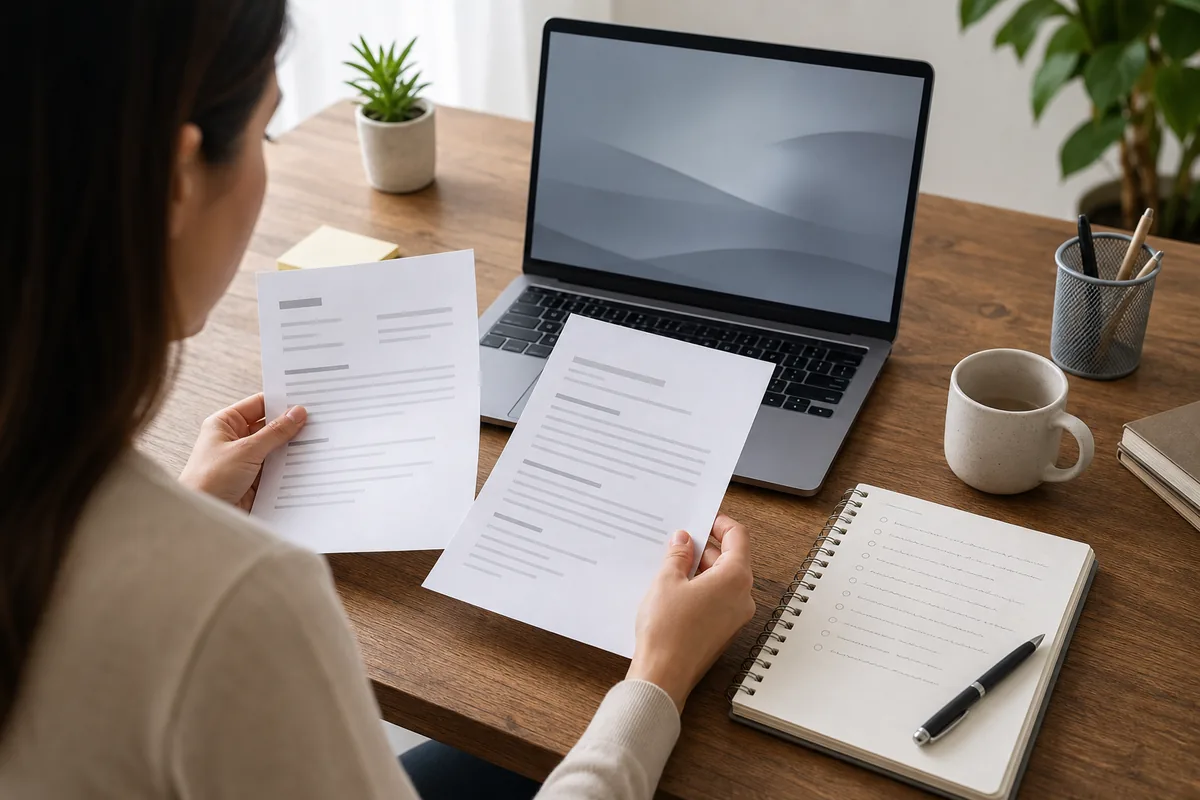
AI-generated illustration.
Create one short practice brief:
- Target role and seniority
- Five competencies the employer is likely to assess
- Three experiences you can discuss truthfully
- Two topics you tend to explain poorly
- Any constraints, such as a 60-second answer limit
Do not upload private code, customer data, internal metrics, or an unredacted resume to an AI system. A concise summary is usually enough to generate relevant practice questions. If you need a place to run the sessions, start with the AI interview assistant and keep your practice brief beside you.
Day 1: Record a Baseline Interview
Goal: Find your current patterns before trying to fix them.
Ask for six questions: two introductory, three behavioral, and one role-specific. Answer each aloud once without restarting. Use a timer, record locally if you are comfortable, and save the transcript or your own notes.
Afterward, mark only observable issues: answers that ran too long, missing context, unclear personal contribution, vague results, or filler words that interrupted meaning.
Artifact: A baseline recording or transcript plus a five-item mistake log.
Completion check: You can name the two problems that most reduce clarity. Those become your priorities for the rest of the week.
Day 2: Build a Small STAR Story Bank
Goal: Prepare flexible evidence, not canned answers.
Choose four real experiences that cover different competencies. For each, write one line for Situation, Task, Action, and Result. The Action should show what you personally decided or did; the Result can be quantitative or qualitative, but it must be accurate.
Indeed's current STAR interview guide describes the method as Situation, Task, Action, and Result and recommends using the job description to anticipate relevant questions.
Practice telling each story in 90 seconds, then ask the AI to identify which STAR element is missing or disproportionate. Do not ask it to invent achievements or metrics.
Artifact: Four one-page story cards, each tagged with two or three competencies.
Completion check: You can retell every story from bullet points while keeping the facts consistent.
Day 3: Practice Behavioral Answers for Specificity
Goal: Replace general claims with concrete evidence.
Run eight behavioral questions focused on your five target competencies. For each answer, ask the interviewer to follow up with “What did you do?” or “What changed because of your action?” These prompts expose vague answers quickly.
Revise only the weakest three responses. Add decision points, tradeoffs, collaboration details, and a truthful result.
Artifact: Three before-and-after answer outlines with the missing detail highlighted.
Completion check: A listener can distinguish your contribution from the team's work and understand why your action mattered.
Day 4: Explain Role-Specific and Technical Work Clearly
Goal: Make your reasoning understandable to the intended audience.
Ask for five questions based on the job description: technical decisions for an engineering role, prioritization for a product role, or analysis choices for a data role. Answer using a simple sequence: clarify the goal, state assumptions, compare options, choose an approach, and explain risks.
LinkedIn's AI-powered interview preparation feature documentation shows how a job description can generate role-specific questions and spoken-answer feedback.
If you are preparing for a technical screen, work through a focused guide such as the HackerRank OA preparation guide, then use the broader interview question library to select realistic topics. Explain one solution without code and one with implementation details.
Artifact: Two structured technical or role-specific explanations.
Completion check: Each explanation states assumptions, alternatives, and a reason for the final choice.
Day 5: Improve Delivery Without Sounding Scripted
Goal: Sound clear and prepared while remaining natural.
Replay Day 1 and note pace, pauses, verbal clutter, eye line, and sentence length. Pick one delivery issue—not five. Repeat three familiar answers while focusing only on that issue. For example, pause for two seconds before responding, shorten the opening sentence, or replace repeated filler with silence.
Use keywords on a note card rather than full sentences so the story can adapt when the interviewer changes the wording.
Artifact: A short comparison recording of the same answer before and after one delivery adjustment.
Completion check: The revised answer is easier to follow without sounding recited or changing the underlying facts.
Day 6: Practice Follow-Ups and Ambiguous Questions
Goal: Stay composed when the interview leaves your prepared path.
Ask the AI interviewer to interrupt politely, challenge one assumption, request a missing detail, and pose two deliberately ambiguous questions. Practice clarifying before answering: restate what you heard, ask one focused question, and then proceed with an explicit assumption if needed.
End each round by writing the follow-up that caused the most difficulty and the evidence you needed but did not provide.
Artifact: A list of five difficult follow-ups and concise response plans.
Completion check: You can handle a changed premise without abandoning your structure or pretending certainty.
Day 7: Run a Full Dress Rehearsal
Goal: Combine the week's work under realistic conditions.
Set up the same device, camera, audio, notes, clothing, and room you expect to use. Run a 30- to 45-minute mock interview without pausing. Include an introduction, four behavioral questions, two role-specific questions, follow-ups, and two questions for the interviewer.

AI-generated illustration.
Review the session once with the scorecard below. Compare it with Day 1 using the same criteria; do not compare two unrelated AI scores. Then repeat only the two weakest answers. If you want a broader view of available practice formats, see the AI interview practice tools guide.
Artifact: One complete rehearsal, one scorecard, and a short next-week practice list.
Completion check: You can identify what improved, what still needs work, and the next specific exercise for each remaining weakness.
Use This Six-Part Review Scorecard
Rate every dimension as clear, partial, or missing. The labels are deliberately qualitative: they force you to point to evidence instead of trusting a mysterious number.
| Dimension | Clear | Partial | Missing |
|---|---|---|---|
| Relevance | Directly answers the question and connects to the role | Relevant example but weak role connection | Avoids or misunderstands the question |
| Structure | Easy to follow from context through result | Main idea is visible but sequencing wanders | Listener must reconstruct the story |
| Specificity | Names actions, decisions, constraints, and outcomes | Includes some detail but relies on general claims | Could describe almost any candidate |
| Ownership | Separates your contribution from the team's | Contribution is implied | Uses only “we” with no personal role |
| Judgment | Explains alternatives, tradeoffs, or lessons | States a choice without much reasoning | Gives an action with no rationale |
| Delivery | Concise, audible, natural, and appropriately paced | Understandable with noticeable friction | Pace or wording obscures the answer |
For each partial or missing rating, copy one sentence from the transcript that demonstrates the problem. Then choose one repair: add context, name your action, explain a tradeoff, state the result, or shorten the opening. This turns feedback into an edit you can test in the next repetition.
Keep the criteria stable across sessions. A useful review asks, “Is the evidence clearer than yesterday?” rather than, “Did the AI give me a higher score?”
Know Where AI Feedback Stops Being Reliable
AI can generate questions, notice patterns, suggest follow-ups, and help you compare two versions of an answer. It cannot know whether your story is true, fully understand an employer's hidden rubric, or reliably predict a hiring decision. It may also reward formulaic language that weakens your authentic voice.
NACE's account of Aurora University career services using ChatGPT for interview preparation emphasizes role-play and feedback while preserving the human element and discussing AI's limits. Follow the same boundary: use AI as a practice partner, then seek human review from a mentor, recruiter, peer, or career adviser for nuance and credibility.
If you are considering a live assistant, review the policy and privacy questions in our research-based Parakeet AI review before deciding whether it belongs in your preparation workflow.
Use AI before the interview, not as concealed live assistance during an assessment. Our research-based guide to live AI interview answer suggestions explains the permission, consent, privacy, and reliability questions to check. Follow the employer's rules, protect confidential information, and make sure every answer represents work you can explain independently.
Frequently Asked Questions
How long should an AI mock interview practice session be?
Use 30 to 45 minutes for daily sessions and a full-length Day 7 rehearsal. Every session should include time for review.
Should I memorize answers generated by AI?
No. Keep factual bullet points, a flexible structure, and a few precise details. Memorizing generated prose can make you sound generic and leaves you unprepared for follow-ups. You should be able to defend every claim in your own words.
How many STAR stories do I need?
Start with four truthful stories that cover several competencies. Add another only when the target role exposes a real gap.
Can AI mock interview feedback replace a human coach?
It can support frequent practice, but human reviewers are better positioned to challenge credibility, context, role nuance, and authenticity.
Continue Practicing
After the seven days, keep one weekly full rehearsal and two short targeted sessions. Use your mistake log to select the next exercise, not a random question generator. When you are ready to test your setup, use the download page and repeat the same scorecard so your progress remains comparable.
The goal is not to produce flawless scripts. It is to make your real experience easier to understand under pressure—and to build a practice loop you can reuse for every future interview.
Choose your next step
Compare another tool or move from research into structured interview practice.