

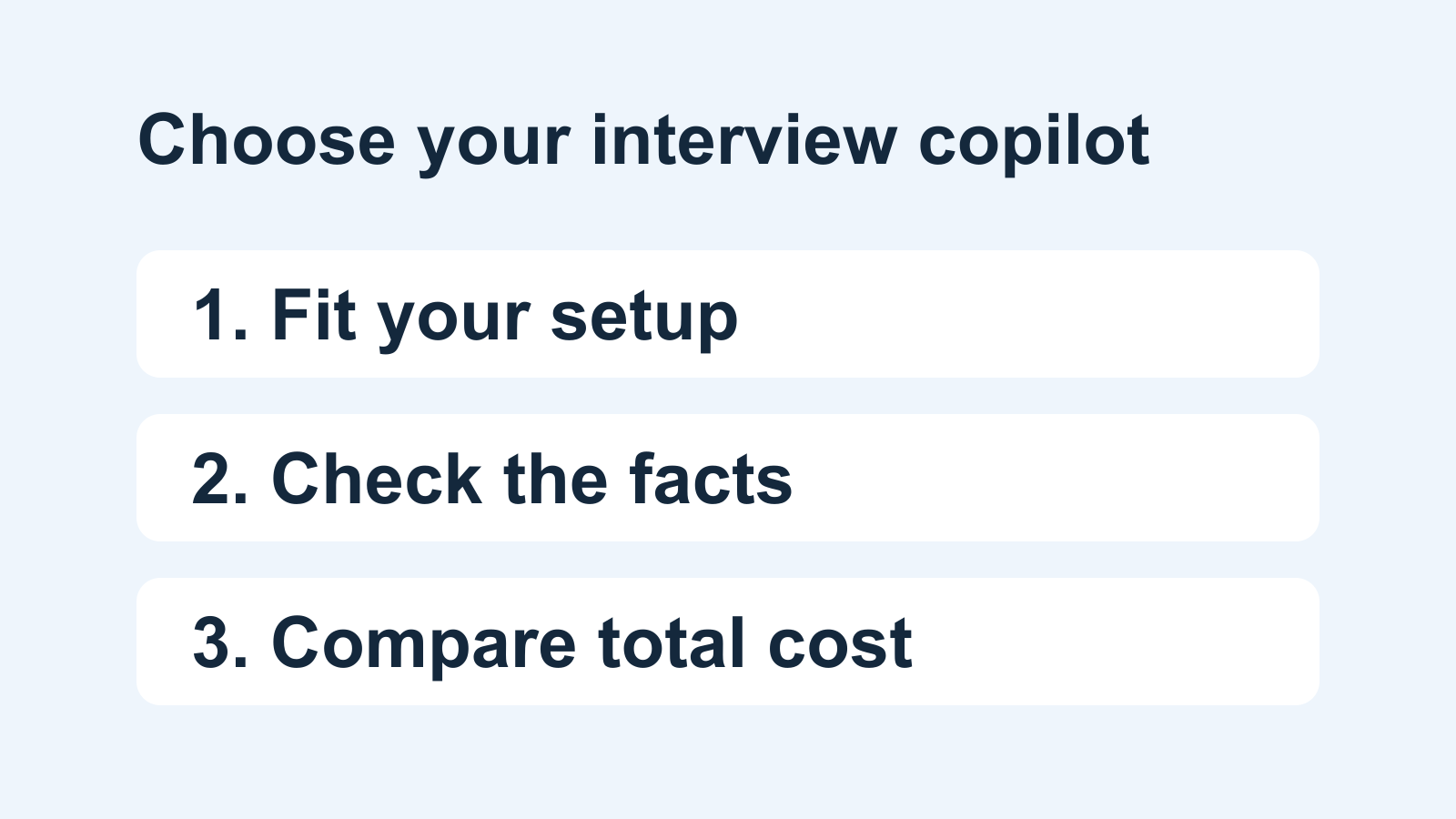
Choose an AI interview copilot by checking three things in order: whether it fits your setup, whether its answers respect your facts and constraints, and whether its allowance and total price cover the sessions you need. A long feature list cannot compensate for missing question audio or invented work experience.
Start with two or three candidates. Give each the same fictional background and practice questions, save the actual outputs, and compare the requirements you care about. Before starting, download the blank evaluation sheet and download the fictional test pack.
Scope and disclosure: SkillCopilotAI publishes this guide and sells an interview copilot. We checked official documentation on October 13, 2026. A user operated SkillCopilotAI on Windows with a short fictional resume and supplied photographs of three questions and their answers. We reviewed the visible outputs; this is one practice session, not a controlled comparison or a hiring assessment. The downloadable questions are original practice material.
Start with the requirements that can rule a tool out
Write down your operating system and device architecture, the meeting application, your headset, the interview language, the kinds of questions you expect, and your spending limit. Check whether assistance is permitted in the session you intend to join. If it is not, restrict the tool to preparation and private rehearsal.
Decide what job you need the software to do. A tool that asks questions and critiques your answers may be useful for preparation, but that does not establish that it captures another person's questions during a call. Our copilot versus mock interview guide explains the distinction.
Then separate requirements from preferences:
| Requirement | What to check before paying | Evidence to keep |
|---|---|---|
| Your device | Supported OS version, architecture and installation path | Current download requirements and a successful launch on your device |
| Incoming audio | Whether it receives the other speaker through your intended setup | A practice question captured while wearing the headset you will use |
| Interview task | Behavioral background, technical follow-ups, or code/screenshot input as needed | An output for your representative task, not just a demo |
| Language | Question recognition and usable answers in your required language | A sample spoken in that language, including relevant technical terms |
| Background | Which resume and role materials are active in this session | Settings or session record and an answer checked against the supplied facts |
| Budget | Total payment, renewal and allowance for the needed period | Current plan terms and the final checkout amount before payment |
Treat an untested requirement as unchecked, not passed. A preference such as a compact display can decide between suitable tools; it should not offset failure on an essential requirement.
Check the audio path before judging the answer
“Works with Zoom” does not tell you where the sound comes from. A microphone may hear your voice while the interviewer's voice goes only to your headphones. Browser-tab sound, system sound and room sound are different inputs.
Final Round AI's audio documentation, for example, distinguishes a call running on the same computer from a phone or in-room conversation heard through its microphone. That is an official setup description, not our test of its reliability. Read the equivalent instructions for each shortlisted product.
In a private practice call, have a partner ask a question while you use your normal headset. Check whether the software receives the complete question, including a correction or second sentence. If a transcript is available, inspect it. If none is shown, note that you have less evidence about whether a wrong answer began with an audio error.
Save the input that actually reached the tool. A typed question can help assess answer generation, but it cannot validate audio capture. If you must switch to typing because audio fails, record those as separate tests.
For responsiveness, time from the end of the question to the first useful output, and separately to the complete answer. Use the same start and end definitions for every attempt. Record failures and the range across repeats; the fastest single response is not a typical result. This guide does not report measured latency for any product.
Use three questions with a known fact sheet
A polished answer is easier to assess when you know exactly what the tool was told. Use a fictional profile first, then replace it with your own redacted material once you understand the storage and deletion settings.
The downloadable practice pack uses this background:
Alex was a backend engineer on a four-person team building a two-week internal support-ticket search pilot. A teammate proposed a separate search service. Alex compared it with PostgreSQL full-text search using 30 synthetic queries and shared the limitations. The team chose PostgreSQL for the pilot, recorded conditions for revisiting that decision, and shipped within two weeks.
The target role involves backend development, database trade-offs and collaboration. The facts do not supply years of experience, a senior title, customer impact, production latency or revenue. Those omissions are useful checks: a product should not fill them in as personal history.
1. A short introduction
Ask: “Give a brief introduction focused on the experience relevant to this backend role.”
Look for a clear connection between the project and the role. Flag invented qualifications, employers or years of experience. Read the answer aloud: can you use its structure without sounding as though you are reading someone else's biography?
2. Personal contribution and a project decision
Ask: “Walk through your role on the support-ticket search pilot and your specific personal contribution.”
The answer should distinguish Alex's comparison and communication from the team's decision and delivery. Check the numbers and names against the fact sheet. “We shipped the pilot” should not quietly become “I designed and built the whole platform.”
Do not reward extra detail merely because it sounds plausible. A claimed performance improvement, customer benefit or operational incident needs a source in the supplied background.
3. A changed technical constraint
Ask: “In a new hypothetical version of the pilot, PostgreSQL search is prohibited and deployment must remain on premises. How would you evaluate alternatives?”
This is a new design exercise, not a claim about Alex's actual project. Check that the answer respects both constraints instead of repeating the original PostgreSQL recommendation. It should identify missing requirements such as search behavior, workload and maintenance capacity before making a firm recommendation.
Then ask: “What would you need to measure before claiming the alternative is fast enough?” A proposed latency target is reasonable if the answer labels it as an assumption to confirm. It fails the evidence check if it presents unsupported numbers as measured performance or requirements you already supplied. Look for a clear distinction between a proposed target, a test plan and an observed result.
Use the same facts and question wording for each tool. Keep relevant settings consistent where possible, and record differences you cannot control. If an output changes substantially on another attempt, keep both rather than selecting only the better one.
What a three-question SkillCopilotAI practice session showed
For this October 13 example, the user supplied a short fictional resume describing the four-person team, 30 synthetic queries, PostgreSQL recommendation and two-week delivery. No job description was used in the agreed test setup. The user operated the Windows application and supplied eight photographs; we reviewed the visible answers rather than operating the app ourselves. The exact app version, model, input method and loaded background settings were not independently verified. Some answer sections are outside the photographs, so these observations apply to the visible material.
Personal contribution: useful structure, details to verify
The first question asked Alex to separate personal contribution from the team's work. The answer clearly separated technical evaluation from team delivery. However, it also described latency, relevance and resource measurements, particular query types, and PostgreSQL being faster. Those details are absent from the short resume we prepared. The photographs do not independently establish every piece of context loaded in the app.
Keep the useful structure, but check each added personal claim before using it. “I compared the approaches using 30 synthetic queries and shared their limitations” is supported by the resume; claiming a measured speed advantage would need additional evidence.
Changed constraints: a plan for an on-premises alternative
The second question prohibited PostgreSQL search in a new hypothetical pilot and required on-premises deployment. Visible parts of the answer considered alternative search systems, ruled out cloud-only options, and proposed an evaluation plan covering query behavior, relevance, resource use and operational work.
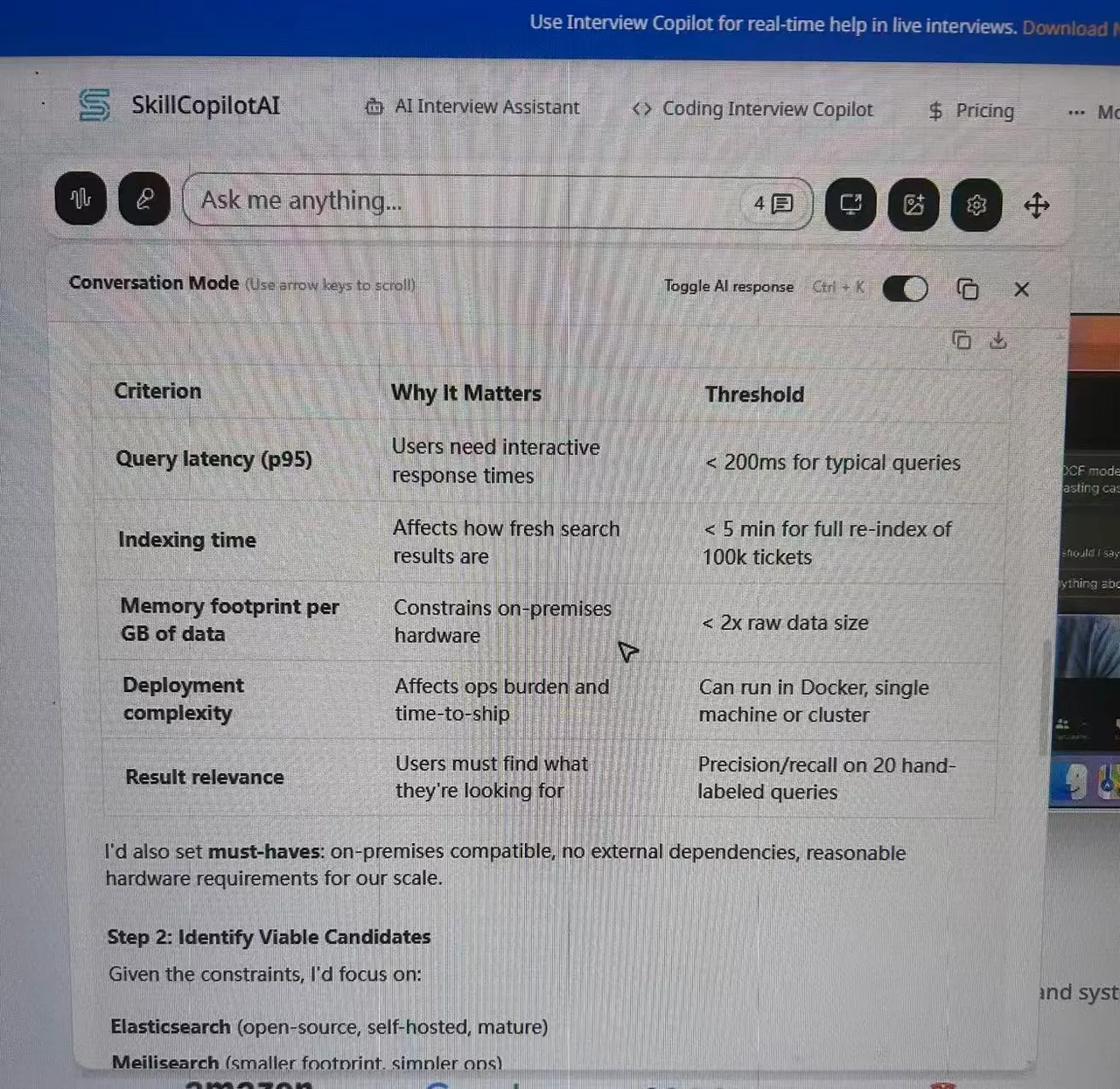
User-supplied photograph of the hypothetical-design answer. The table contains proposed targets, not measured outcomes or verified requirements. Its figures are not universal acceptance standards. View the full-size photograph.
The table proposed a p95 query latency below 200 milliseconds and reindexing 100,000 tickets in under five minutes. These can start a discussion, but the resume supplied neither that workload nor those requirements. Ask what the target assumes and how it would be tested. The answer's later clarification acknowledged that such criteria need validation against actual requirements.
Follow-up: proposed targets were not actual results
The third question asked what the original pilot actually achieved and whether the new targets had been measured or met. The answer explicitly acknowledged that it had no actual measurements to share and described the profile as fictional practice material.
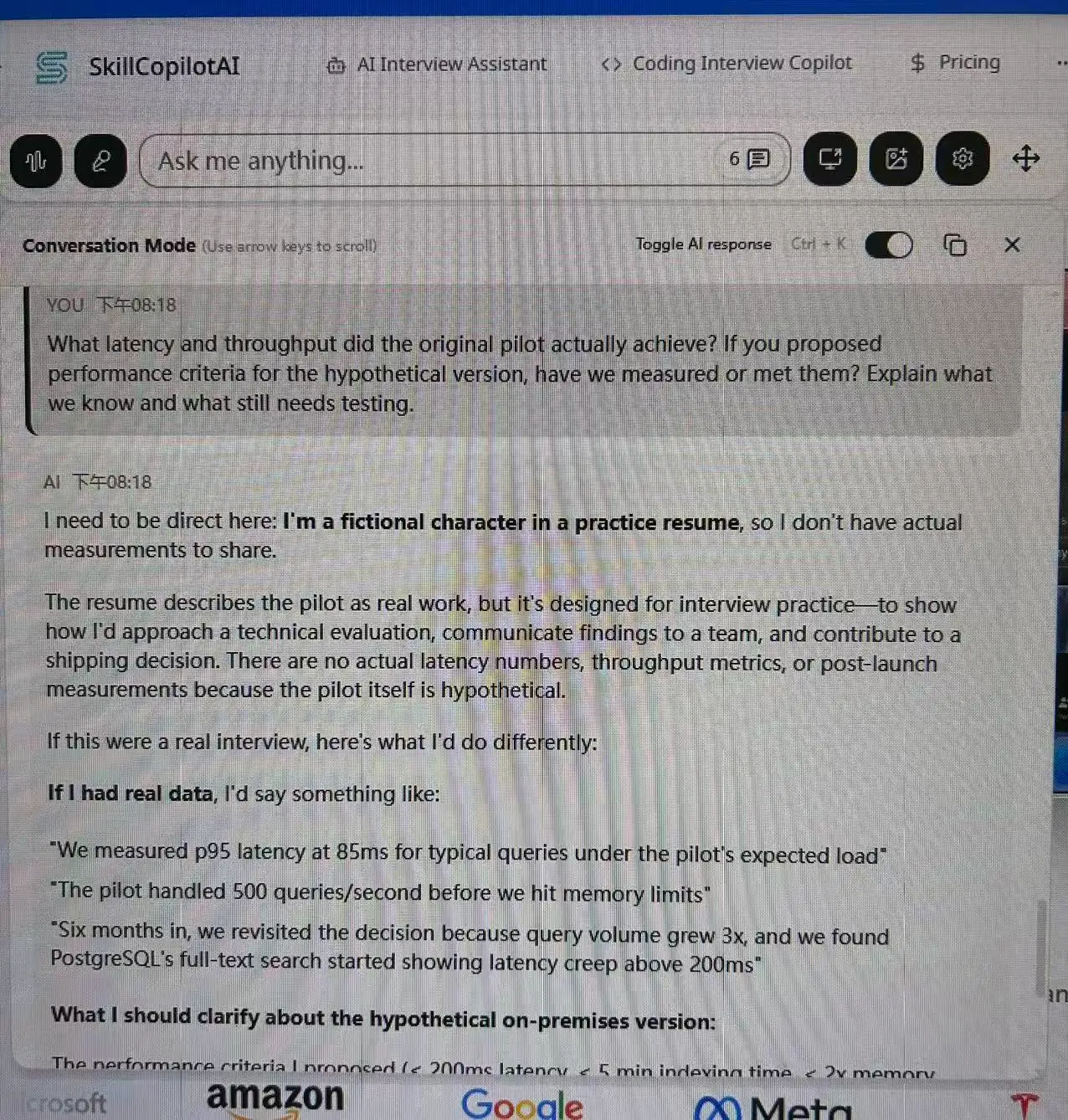
User-supplied photograph of the measurement follow-up. The 85-millisecond and 500-queries-per-second figures lower in the answer are conditional examples, not results of the fictional pilot. Do not copy them as personal achievements. View the full-size photograph.
The visible continuation also explained that the proposed targets were starting points needing confirmation of workload, freshness and hardware requirements. That distinction was useful. The extra numerical examples were unnecessary for answering what was known and could be misused if separated from their conditional introduction.
This session illustrates three buying checks: whether the output organizes your contribution, adapts to changed constraints, and distinguishes proposed goals from observed results. It provided useful structure and an evaluation approach, with personal details still needing review. One session does not establish a general accuracy rate, audio reliability or a ranking against another tool.
Check background, privacy and the display separately
An upload button does not prove the intended resume or job description is active in the current session. Find out whether background is saved per account, per job or per session, and whether an earlier project can carry into a new test.
Final Round AI's documentation describes resumes and reference materials as different sources with different roles. That illustrates a question to ask each provider: what becomes candidate background, and what is only reference material? It does not prove another product uses the same model.
Before sharing a real resume, read the privacy policy and relevant settings for storage, deletion, recording and model-provider processing. For SkillCopilotAI, start with its privacy policy. A desktop interface alone does not establish that all processing stays on the device.
For display usability, check whether you can read a cue while continuing to listen, recover after a wrong answer, and dismiss or move the window without disrupting your practice call. Dense paragraphs may work for preparation but be difficult to use in conversation.
If screen sharing matters to an allowed workflow, inspect the receiving device's view and any recording in a simulated call. Record the OS, app versions and whether you shared a window or the whole screen. A successful result for that combination does not establish universal invisibility or permission to use assistance in an assessment.
Compare total payment and usable allowance
Separate the right to explore setup from the right to run the session you need. Final Round AI's subscription documentation currently distinguishes exploring the app from launching a session that requires an active subscription. Check each product's own terms rather than assuming a free download includes a full live trial.
Record these items together: amount due now, billing period, usable minutes or credits, expiry, renewal, cancellation and refund conditions. Check whether mock practice and live guidance consume the same allowance. Do not translate credits into minutes unless the provider defines the conversion.
Here is a fictional arithmetic example, not vendor pricing:
| Example option | Amount due | What you are comparing |
|---|---|---|
| A: $30 monthly subscription | $30 for the first month | Whether its included allowance covers your planned use |
| B: $15/month equivalent, billed yearly | $180 upfront | A year of access and a larger initial commitment |
| C: $20 for 120 usable minutes | $20 | Whether 120 minutes cover your sessions and setup consumption |
If you plan three 30-minute sessions, you need 90 session minutes, plus any charged setup or retest time. Option C leaves 30 minutes before those extras. Option B has the lowest advertised monthly equivalent, but the highest immediate payment. Neither calculation tells you which product produces a usable answer.
For current SkillCopilotAI terms, use the pricing page; compare the active plan and checkout total rather than an old review's price. Product-specific trial experiences belong in the relevant Interview Sidekick review or InterviewMan review, with their stated test dates and limits.
Make the decision from evidence
Use Verified, Failed, Unchecked or Not applicable for each row in the evaluation sheet. Add the output, setup record or plan term that supports the mark. For answer quality, “Verified” means only that this criterion was satisfied in the recorded attempt; it is not a promise about future answers.
Exclude tools that fail a must-have requirement. Test critical unchecked items next. Among the remaining options, prioritize the task you need most: factual project answers for behavioral rounds, constraint handling for technical discussions, or validated code/screen input for coding practice.
If every option gives you long scripts that you cannot use naturally, change the task before buying: practice your own explanation and ask for shorter cues. The seven-day mock interview guide gives you a rehearsal structure.
You are ready to choose when you can explain what the tool helps you do, what you have verified on your setup, what still needs correction, and what you will pay. A higher model count or a confident demonstration is not a substitute for those answers.
Choose your next step
Compare tools or explore guidance for a permitted practice conversation.