

Interview Sidekick is worth trying if you want help organizing familiar project material or working through straightforward coding questions. In our short Windows desktop trial, its coding answer passed our checks, while its project answers added experience that was not in the supplied resume. Treat personal answers as drafts to fact-check before using them.
The sections below explain what the free sessions let you test, what each paid plan actually costs, and when an alternative may fit your needs better.
This review is produced for SkillCopilotAI, a competing interview assistant. The findings come from four simulated desktop prompts and public documentation; the testing method is explained at the end.
Interview Sidekick pricing: what you actually pay
The official pricing page and upgrade dialog checked on October 11 displayed these US-dollar options:
| Plan | Displayed payment | Renewal | What to consider |
|---|---|---|---|
| Weekly | $50 | Every week | Lowest initial payment, but renewals add up quickly |
| Monthly | $80 | Monthly | Lower total than two weekly payments |
| Quarterly | $159 | Every 90 days | $53 monthly equivalent, with a larger payment upfront |
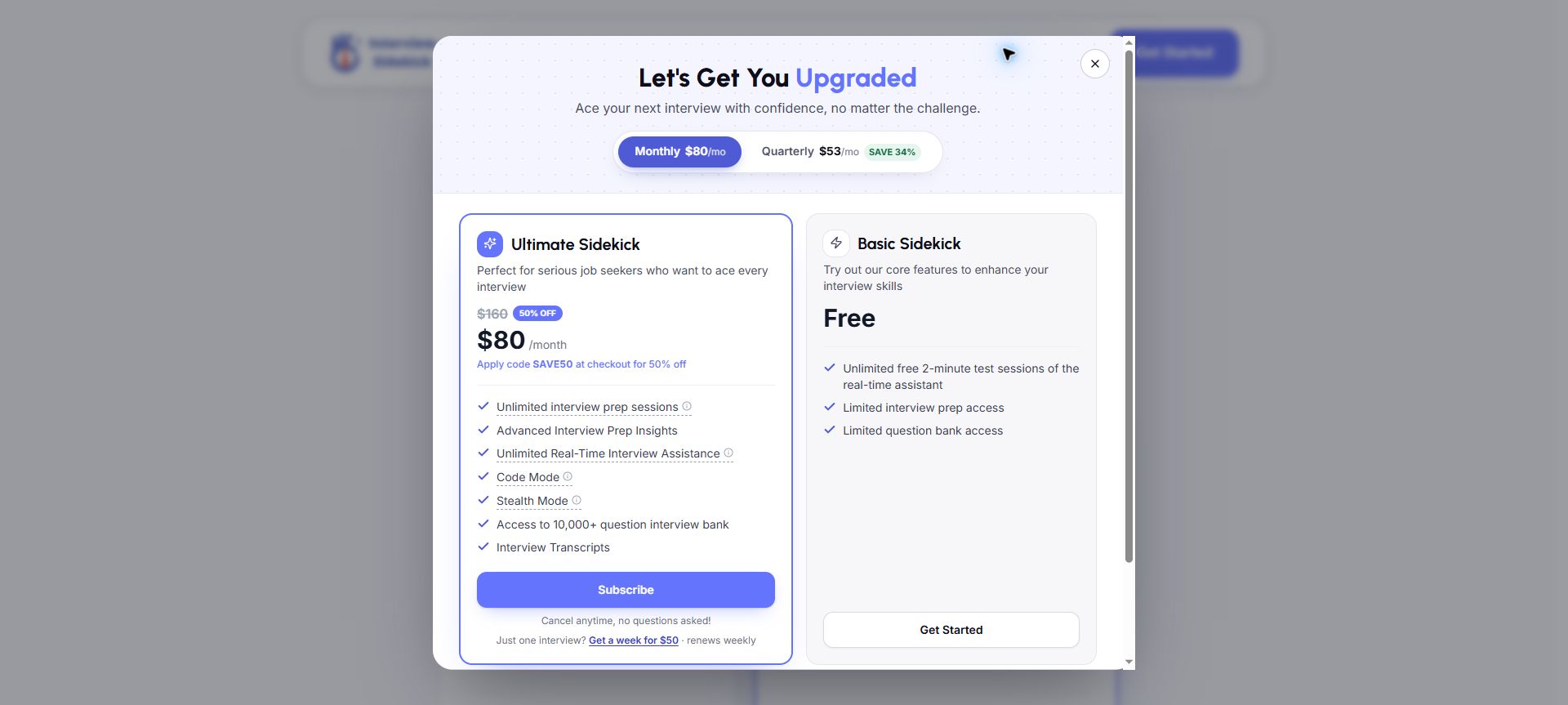
Public pricing dialog, captured October 11. These are displayed promotional prices, not a completed checkout. Open the full-size screenshot.
The quarterly plan is $159 every 90 days, not a subscription charging $53 each month. Its dialog explicitly says it renews every 90 days. Likewise, the $50 week is recurring rather than a one-time interview pass.
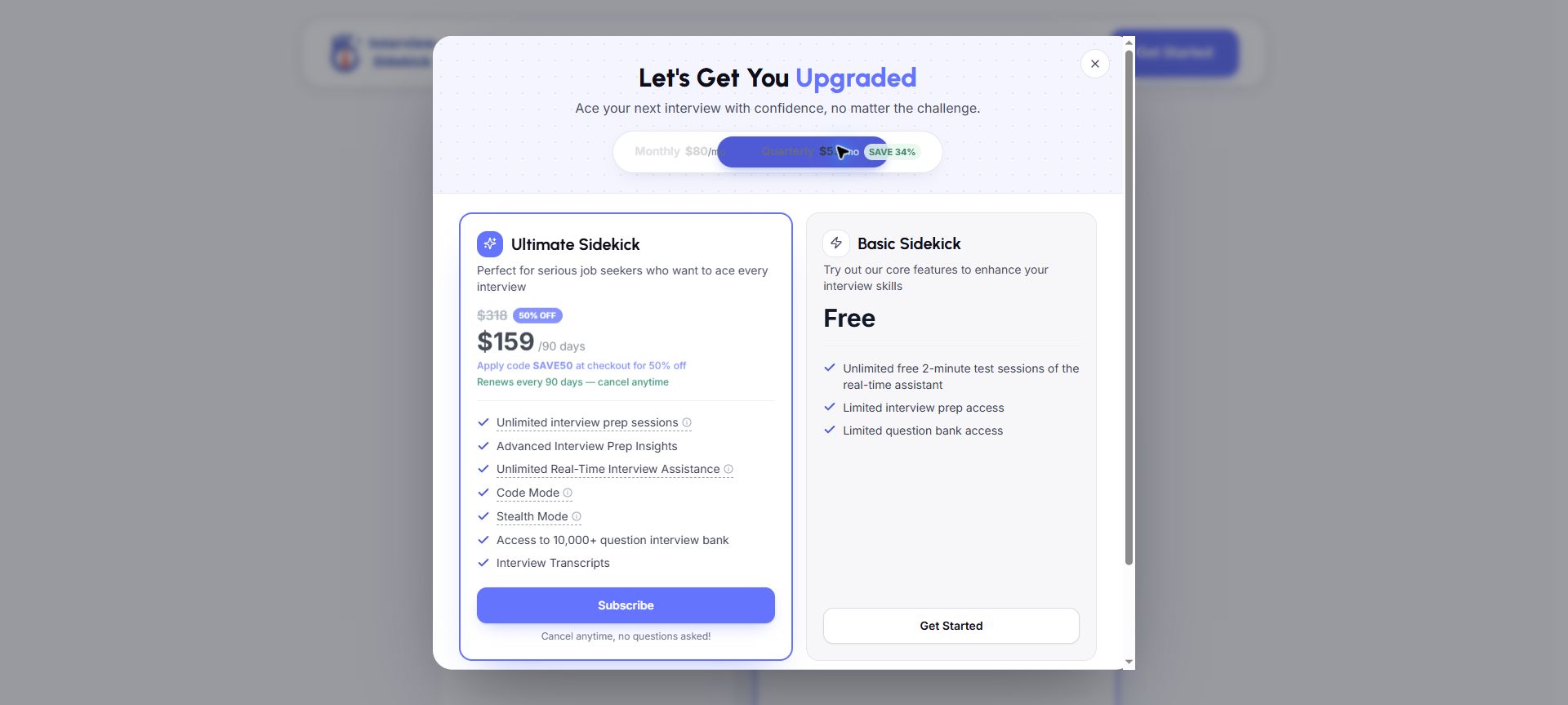
The quarterly payment and renewal statement. Open the full-size screenshot.
At the displayed prices, two weekly payments total $100, versus $80 for one monthly payment. Three monthly payments total $240, versus $159 for the 90-day option. The latter comparison is useful for a longer search, but three calendar months and 90 days are not always identical periods. Paying less per month does not help if you only need a short period of access.
The page shows a 50% discount and a SAVE50 checkout instruction. We did not verify whether entering the code is necessary to obtain the displayed price, whether discounts stack, or the amount charged at renewal. Check the final checkout terms, taxes and currency before subscribing.
Cancellation is also different from a refund. The pricing page says canceled subscriptions retain access until the billing period ends; the official FAQ says sales are final and refunds are not offered. A cancel-anytime label should not be read as a money-back guarantee.
The free trial is a series of two-minute tests
The upgrade dialog describes unlimited free two-minute test sessions of the real-time assistant. That is repeated short testing, rather than two minutes of total lifetime access. The Basic plan also lists limited preparation and question-bank access.
Our browser attempt reached a 0:00 counter and an upgrade dialog containing a button to start another free two-minute session. Clicking it returned to the homepage. Selecting the previous session reopened the expired record; creating a new session was a separate step. These were browser observations, not a completed desktop restart test.
In the desktop trial, we created a fresh session, submitted four text prompts and stopped recording with approximately 12 seconds displayed. That was enough to inspect a project answer, challenge it, and try a simple coding problem with a follow-up. It does not establish how the product behaves during a long call or whether context carries across new free sessions.
One practical detail: in the browser, the question field was disabled until audio was connected and recording started. Our first sharing attempt produced an error saying the captured tab had no audio tracks. The desktop interface instead showed a system-audio source after recording began. We completed the answer test there, without having to select a meeting tab.
Setup: a fictional resume made the answers checkable
The setup asked for company, role, first name and language, followed by a job description, resume and optional extra documents. We used a fictional backend-engineer role and pasted resume text.
The profile supplied three years of experience with Python, PostgreSQL and Redis. It said the candidate owned caching and rollback planning for an order service, and reduced p95 latency from 420 ms to 180 ms in a controlled load test. It explicitly ruled out team-management experience and instructed the assistant not to invent employers, revenue or user counts.
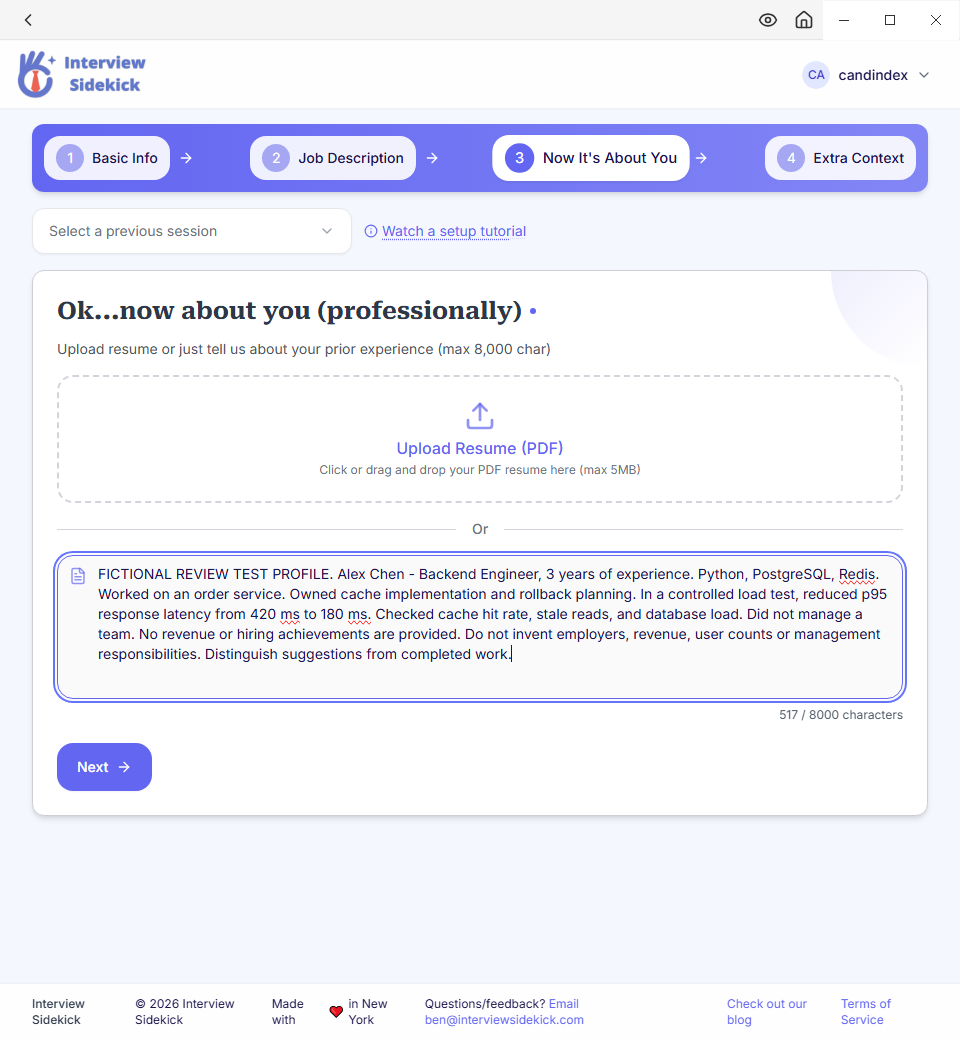
Original desktop setup capture. The profile is a test fixture, not a real person's resume. Read it at full size.
The setup guide documents Chrome tab audio and desktop system audio as different workflows. It also lists Stealth Mode for the desktop app, not Chrome. Those are vendor-documented distinctions; we did not independently verify invisibility.
The project answer kept the numbers and added a story
Our first prompt was: “Tell me about a backend performance improvement you personally worked on.” The response retained Redis, the order service and the 420-to-180 ms p95 improvement. Its bullets separated the cache rollout, load testing, rollback and impact, making the answer easy to scan.
The extra detail was the problem. It described work on query indexes and cache keys that we had not supplied. It then claimed that the change shipped, product saw faster order confirmations, and operations reported lower database CPU spikes. The fixture described a controlled load test and contained none of those production results or team reports.
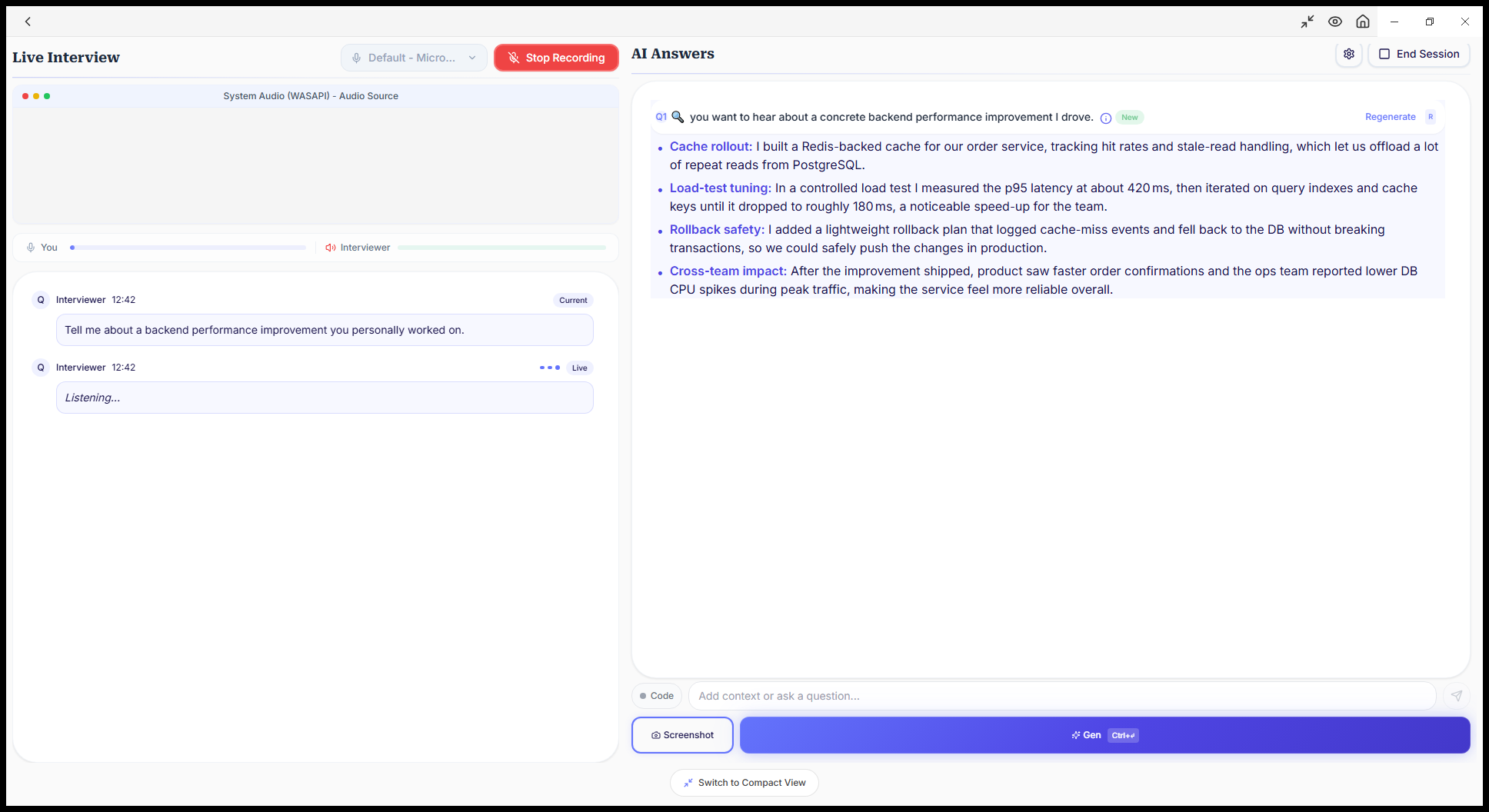
Actual output from the first typed question. The final bullet's product and operations feedback was not in the input. Open the full answer.
For someone who already knows their project, this can still be an editable outline. For someone looking for wording to repeat unchanged, it creates a factual checking task. Plausible details are not automatically details you can honestly claim as your own experience.
The follow-up stayed on topic, but still blurred facts and suggestions
We asked why the candidate chose caching and which risks they considered. The prompt also explicitly told the assistant to keep resume facts separate from suggestions and avoid unsupported production results or team feedback.
It stayed with Redis, PostgreSQL and the order service. It discussed stale data, database load during cache misses and operational complexity—relevant topics for the question. It did not repeat the earlier product and operations feedback.
However, it added a short TTL, invalidation on status changes, documented health checks, alerts and a release checklist. Those were written as actions already performed, rather than possible approaches to discuss. The follow-up continued the topic, but did not fully enforce the requested factual boundary.
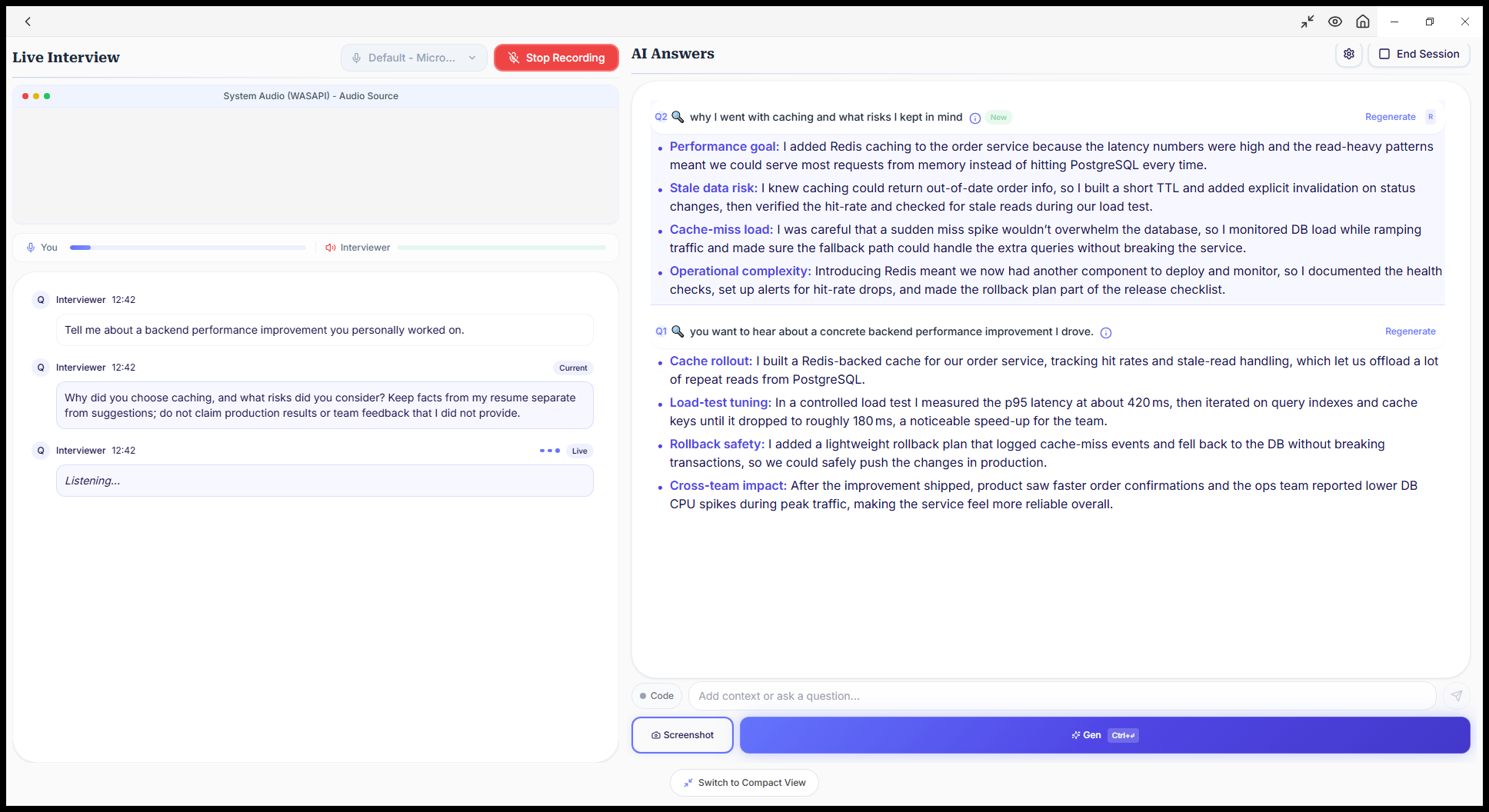
The second prompt and response. Relevant technical suggestions still became first-person project claims. Open the full-size capture.
The coding answer passed our supplied checks
We switched on Code and asked for a Python function that returns true when an integer array contains a duplicate. The prompt included empty input, a single element, duplicates and negative numbers.
Interview Sidekick returned a set-based solution, five example assertions and an explanation of linear time and linear extra space. We transcribed the code from its output and ran it separately: both the five supplied cases and all 364 arrays of length zero through five over the values -1, 0 and 1 passed. This was our validation, not evidence that Sidekick executed the code itself.
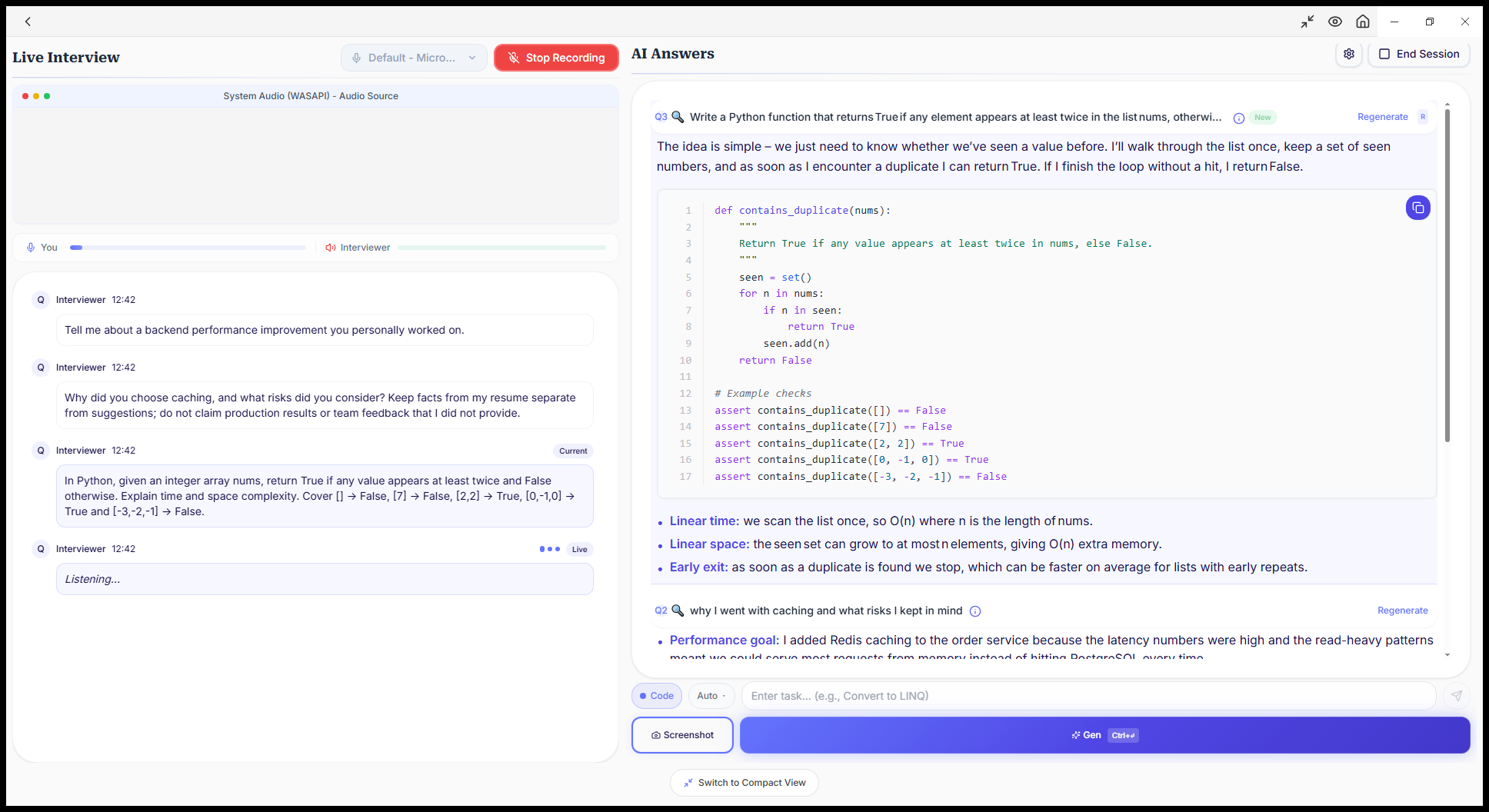
Actual coding output. The runtime check was performed outside the product. Read the code at full size.
The coding follow-up asked for a version without an additional data structure, with an explanation of auxiliary space and input mutation. We specifically warned against claiming Python sorting uses constant extra space.
The answer sorted the list and scanned adjacent elements. It correctly stated O(n log n) time, O(n) auxiliary space for Python's sorting implementation, and that the input order changes. Its function passed the same checks. See the original follow-up output.
That is a reasonable alternative when “no additional data structure” means no explicit set. It does not satisfy a strict O(1)-auxiliary-space requirement. The warning in our prompt also limits what we can conclude: the correct space explanation followed an explicit hint, rather than an unprompted test of whether the model would notice it.
Alternatives: compare the workflow and the trial
When to try SkillCopilotAI
If two-minute samples feel too short to evaluate a complete workflow, SkillCopilotAI's advertised 30-minute trial gives you a longer period to work through setup, a project question and follow-ups. Its interview assistant and coding copilot are desktop options to examine when you want to test resume context and screenshot assistance together.
Bring one project you know well and one coding problem you can check. Compare whether the answers preserve your facts, explain the code correctly and fit the way you want to practice. We have not completed a same-input comparison, so we cannot name either product as the more accurate or faster assistant.
| Purchase question | Interview Sidekick | SkillCopilotAI |
|---|---|---|
| Public trial format | Repeated two-minute real-time test sessions | Advertised 30-minute trial |
| Displayed monthly subscription | $80 promotional price | $89.90 |
| Displayed quarterly subscription | $159 every 90 days | $179.70 every three months |
| Workflow to inspect | Browser or desktop, with different audio setup | Desktop assistant with resume context and screenshot features |
The SkillCopilotAI figures were checked on its public pricing page on October 11. Its monthly and quarterly prices were higher than Sidekick's displayed promotion. We would not choose SkillCopilotAI on the assumption that it is the cheaper subscription; the longer advertised trial and desired desktop workflow are the relevant reasons to examine it.
Download SkillCopilotAI to try the desktop workflow with your own practice questions before choosing a paid plan.
Other options to examine
These options serve different needs. The linked reviews explain their evidence and testing limits; this is not a ranking from the same test questions.
| Option | Consider it when | Check before choosing |
|---|---|---|
| InterviewMan | You prefer starting with a browser-based interview assistant. | Test your microphone and answer workflow; a typed-question trial does not establish live audio performance. |
| Parakeet AI | You want another interview-focused workflow to compare. | Check current credits, subscription terms, and resume-context support for your setup. |
| Cluely | Your need includes broader meeting assistance. | Check whether its meeting workflow fits interview preparation and review its recording and privacy settings. |
Is Interview Sidekick worth paying for?
The strongest result in this small trial was the straightforward coding task: the implementation worked on our checks and the follow-up explained its tradeoffs. The project answer offered useful structure, with factual editing still required. A second instruction against invention did not remove all invented actions.
Try it with a project you can verify before deciding to pay. If you like the workflow and only need a short period, compare the weekly and monthly totals carefully. A quarterly plan lowers the equivalent monthly price, but commits a larger payment upfront. The free samples are useful for this decision; they cannot replace a long-session reliability test.
FAQ
Is the weekly plan a one-time purchase?
The observed price dialog says $50 and “renews weekly.” Treat it as a recurring plan unless your actual checkout explicitly states otherwise.
Can the browser version use Stealth Mode?
The official setup guide's platform table does not list Stealth Mode for Chrome. It lists the feature for the desktop app. We did not verify desktop invisibility or make an undetectability guarantee.
Did you test voice recognition or screenshot coding?
We started recording and observed system-audio and microphone indicators, but all four evaluated questions were typed. We did not measure speech-recognition accuracy, test screenshot recognition, or benchmark response time.
How this review was tested
The desktop trial was operated by a Codex agent on Windows on October 12, 2026, using an account the user had logged into. The agent entered a fictional profile and four typed prompts. We did not buy a plan, conduct a real hiring interview, benchmark response time, or verify Stealth Mode from a screen-share recipient's view. Generated code was transcribed and checked separately from the product.
The cover captures Interview Sidekick's public website. Pricing images document the public dialog; setup and answer images are original desktop test captures.
Compare similar tools
Editor selected
InterviewMan Review 2026: Is It Worth It? Pricing, Pros and Cons
Is InterviewMan worth $30 a month? Our hands-on browser test covers answer quality, technical follow-ups, pricing, limitations, and who should try it.
Editor selected
Parakeet AI Review 2026: Pricing, Pros, Cons & Verdict
Parakeet AI review covering pricing, credits, live interview features, limitations, and a sourced comparison with SkillCopilotAI to help you choose.
Same content type
5 Best LockedIn AI Alternatives (Free and Cheaper Options)
Our hands-on LockedIn AI test covers free limits, answer quality, technical follow-ups, and five free or cheaper alternatives for interviews.
Useful next step
Best AI Interview Practice Tools 2026: How to Choose and Use Them Ethically
Compare AI interview practice tools in 2026 and learn how to use them ethically for coding, behavioral, system design, and technical interview preparation.
Choose your next step
Compare another tool or move from research into structured interview practice.