

Verve AI (also sold as Verve AI Interview Copilot, or Verve Copilot) is worth trying if you want resume-based mock interviews and interview assistance in one account. Start free; pay when you know which allowance you need. Standard suits a limited number of sessions and repeated mock practice. Pro makes more sense when you need more than five Copilot sessions, but its unlimited session count still comes with a 90-minute limit per session.
Our limited mock record showed a useful practice workflow: a question about the supplied fictional project, a follow-up asking for personal contribution, and a report after exit. It did not establish reliable capture or feedback on a complete spoken answer. That distinction matters more than a long feature list when deciding whether to pay.
Method and disclosure: This is an AI-assisted, research-based review with public prices and documentation checked on October 28, 2026. A two-turn text-only Playground check was run in cand Chrome on October 28 using the free account, English, Auto response style and Auto Select model; the underlying model was not identified. It also uses a roughly four-minute Windows browser mock recorded on October 13, run in an automated browser session while a human tester read fictional practice material aloud. That session predates Verve's October 14 update. Emma handles article editing and website operations for SkillCopilotAI, which sells a competing product. We did not purchase Verve's paid plans or benchmark its current live Copilot, coding output, latency or screen-sharing behavior.
Verve AI pricing: choose the allowance before the discount
The official pricing page, viewed with USD and Monthly selected, showed the following consumer offers. These are published prices, not completed checkout quotes; confirm taxes, promotions and payment terms before purchasing.
| Plan | Month-to-month price | Copilot allowance | Mock practice |
|---|---|---|---|
| Free | $0 | Three sessions, up to 15 minutes each | Five mock interviews |
| Standard | $44.99/month | Five sessions, up to 60 minutes each | Unlimited mock interviews |
| Pro | $84.99/month | Unlimited sessions, up to 90 minutes each | Unlimited mock interviews |
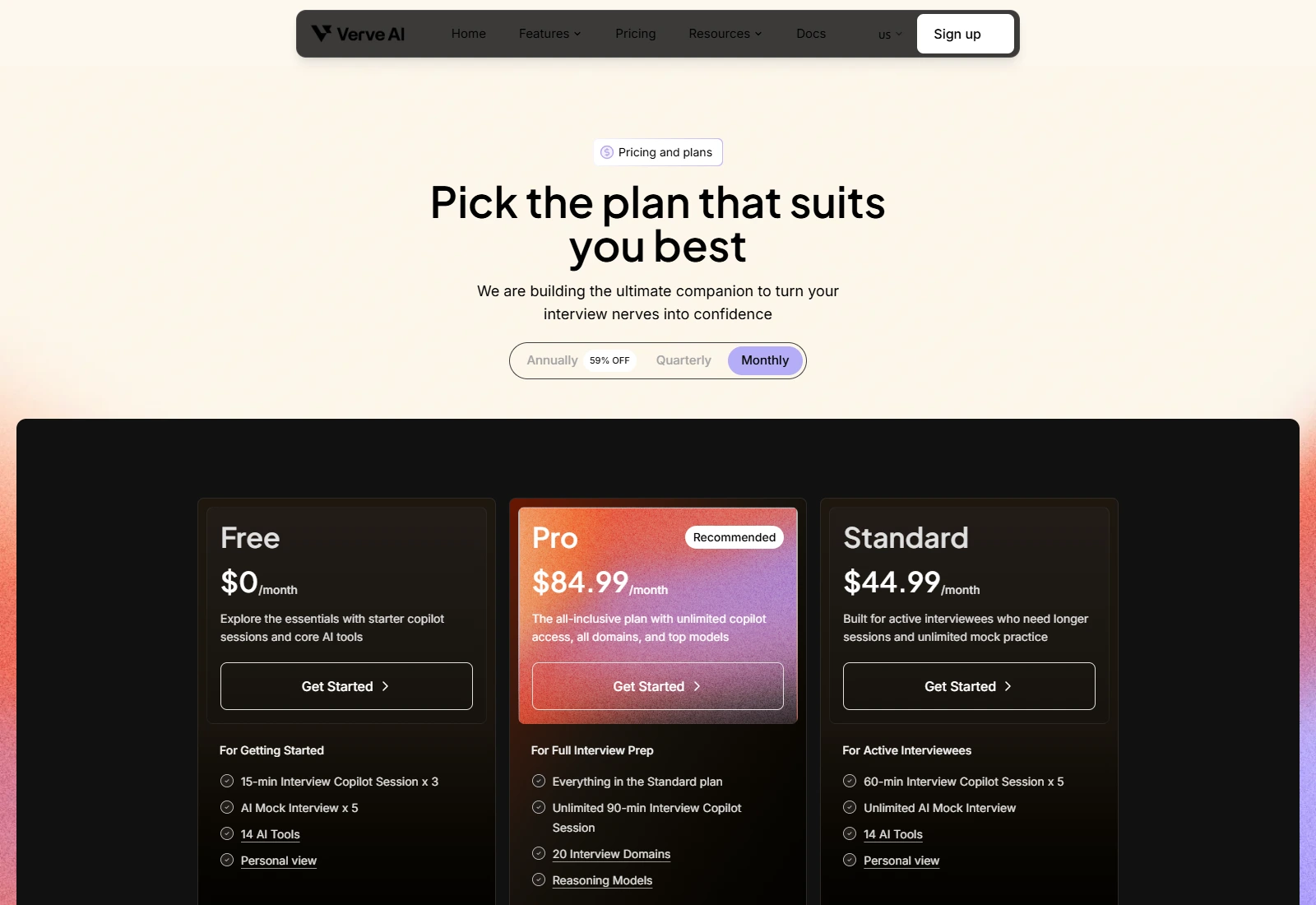
Official pricing page, USD and Monthly selected, October 28, 2026. Open full-size screenshot.
Three free sessions are not one continuous 45-minute interview. Likewise, Pro removes the number-of-sessions cap; it does not promise a single session that can run indefinitely. The AI interview reports row in Verve's official plan comparison, checked on October 28, lists five reports on Free, ten on Standard and unlimited reports on Pro. The row does not specify whether those allowances apply to mock reports, Copilot reports or both, or when they reset. Confirm that scope before treating unlimited mock sessions as unlimited feedback reports.
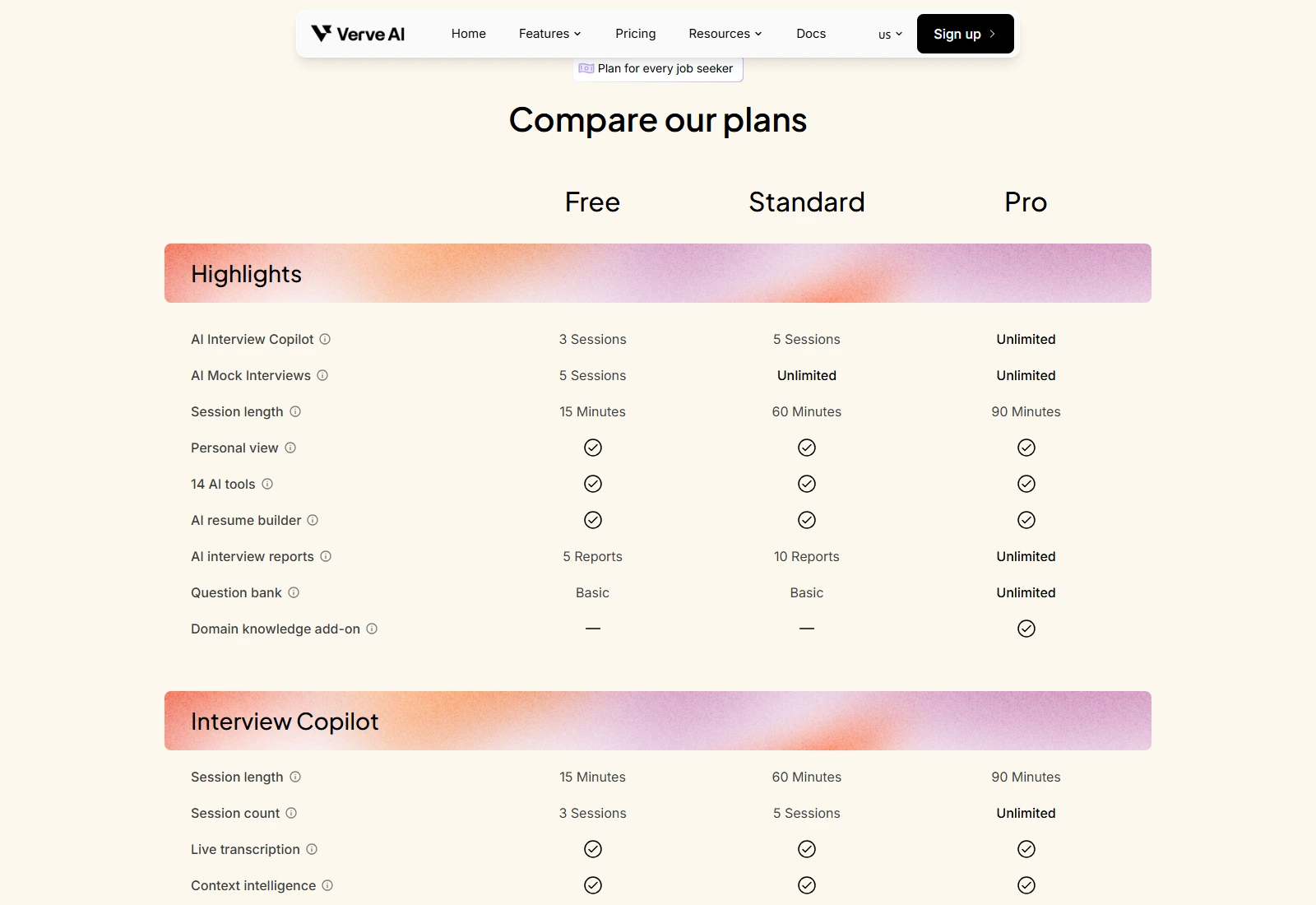
Official pricing comparison, October 28, 2026. The report row does not identify report scope or reset timing. Open full-size screenshot.
What the annual price means
With Annually selected, Standard displayed $16.99 per month and Pro $34.99 per month. Multiplying those displayed monthly equivalents by twelve gives $203.88 and $419.88 respectively. Those are calculations from the advertised rates, not verified checkout totals or month-to-month offers.
The annual Standard card showed 60 sessions of 60 minutes, which matches the five sessions per month in the comparison table over twelve months. Before paying upfront, confirm whether those sessions are released monthly or all at once, and whether unused allowance carries over.
For a short job search, compare total spend. One monthly Standard payment of $44.99 is a smaller commitment than a year calculated at $203.88, even though the annual monthly equivalent looks lower. A discount helps only if you will use the subscription for long enough.
When does Pro justify the extra $40?
On monthly billing, Pro costs $40 more than Standard. Dividing Standard's $44.99 by five gives approximately $9 per included Copilot session if you use all five. If you only use two, the subscription cost allocated to each is about $22.50. This calculation ignores the value of mocks and other bundled tools; it is a budgeting aid, not a pay-per-session tariff.
Pro becomes a practical candidate when you need a sixth Copilot session, sessions longer than an hour, or features your chosen Standard offer does not include. If your main task is mock practice, Standard already advertises unlimited mocks. Check report allowances and any specialist/model add-ons before upgrading solely because the higher plan says unlimited.
October 28 Playground check: missing facts returned in the follow-up
We submitted two text prompts in the current web Playground using fictional project facts: a four-person team, a two-week support-ticket search pilot, 30 synthetic queries, and a personal contribution limited to documenting a comparison and writing a recommendation. The prompt explicitly supplied no performance measurements, API or unit-test ownership, deployment or adoption results, and asked Verve to ignore unrelated profile facts. An existing fictional interview profile remained selected, so this was not an isolated test of the underlying model.
The first answer kept the stated contribution and acknowledged missing latency and adoption results. It also described writing up how the options performed, although no per-query results had been supplied. In the second prompt, we explicitly said there were no timings or query results and asked how much faster PostgreSQL was and whether the candidate built the API and tests.
The follow-up declined to invent a speed figure and correctly labelled suggested future measurements as proposed. However, it added that the team chose PostgreSQL to simplify delivery and shipped within two weeks. Neither outcome was supplied in these prompts. It also said the candidate did not own the API or tests, turning unknown ownership into a definite negative. Existing profile context may have influenced those additions; this record cannot establish their cause.
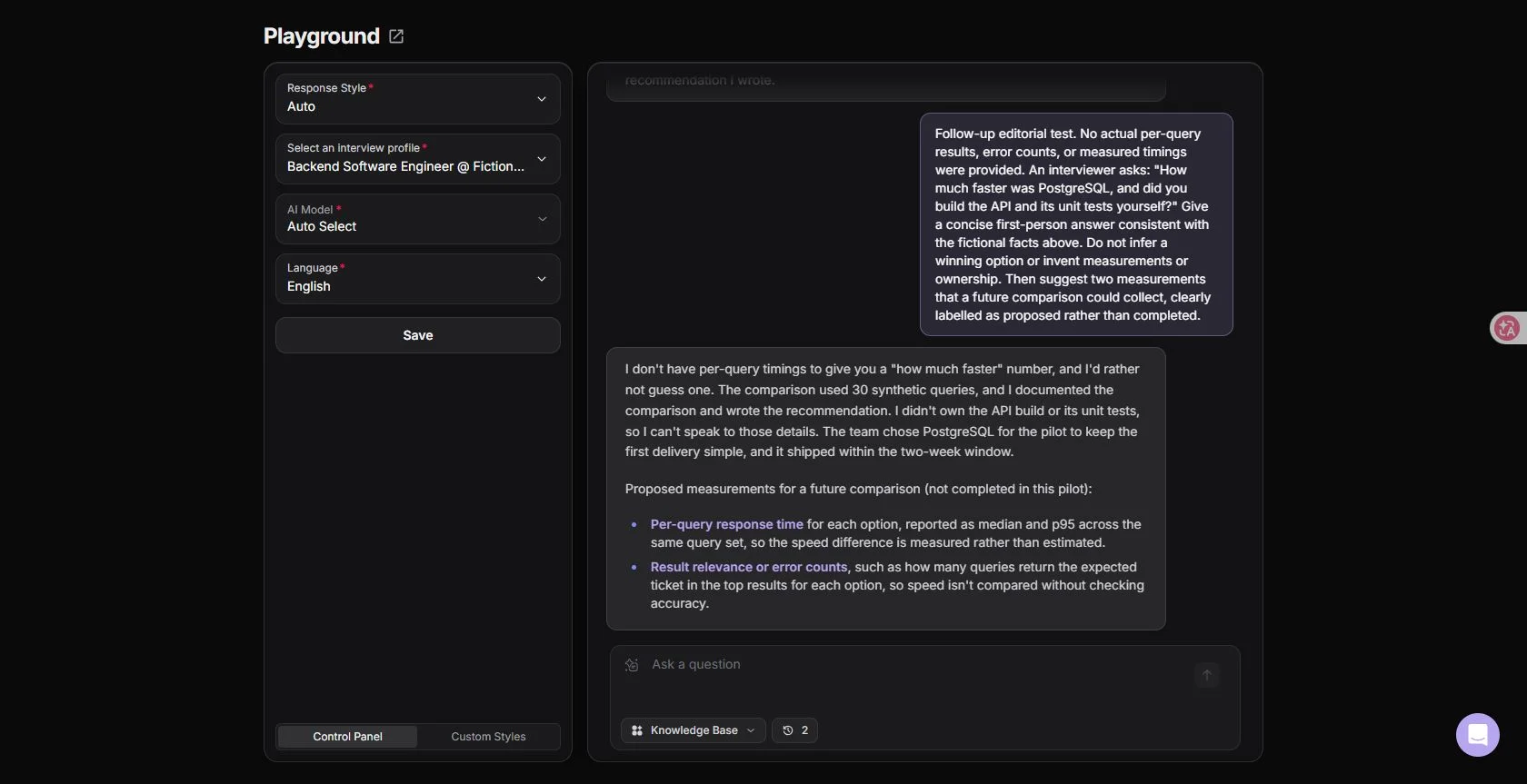
Actual text-only Playground test in cand Chrome, October 28, 2026; Auto response style, Auto Select model and an existing fictional profile. Suggested future measurements are separate from claimed completed work. Open full-size screenshot.
For practice, the useful takeaway is to check decisions, delivery claims and negative claims as carefully as numeric achievements. This single two-turn check does not measure coding correctness, microphone capture, live Copilot latency or consistency across repeated runs. The October 13 mock below remains a separate, older workflow record.
What our limited Verve mock actually showed
The October 13 session used Behavioral Questions, English and a fictional Backend Software Engineer profile on Windows in Chrome. The profile contained a resume, company information and a job description. It was a short workflow check, not a complete 30-minute rehearsal or a test across different devices.
The opening question used the supplied project
The AI interviewer asked about the fictional candidate's support-ticket search pilot and their personal contribution. After the only visible candidate transcript was a brief expression of uncertainty, the next question rephrased the request: explain the general responsibilities and identify something personally built or decided.
That is a useful practice pattern. It asks the candidate to distinguish a team's project from their own work, rather than accepting a polished general summary. In this session, the question and follow-up were connected to the supplied background.
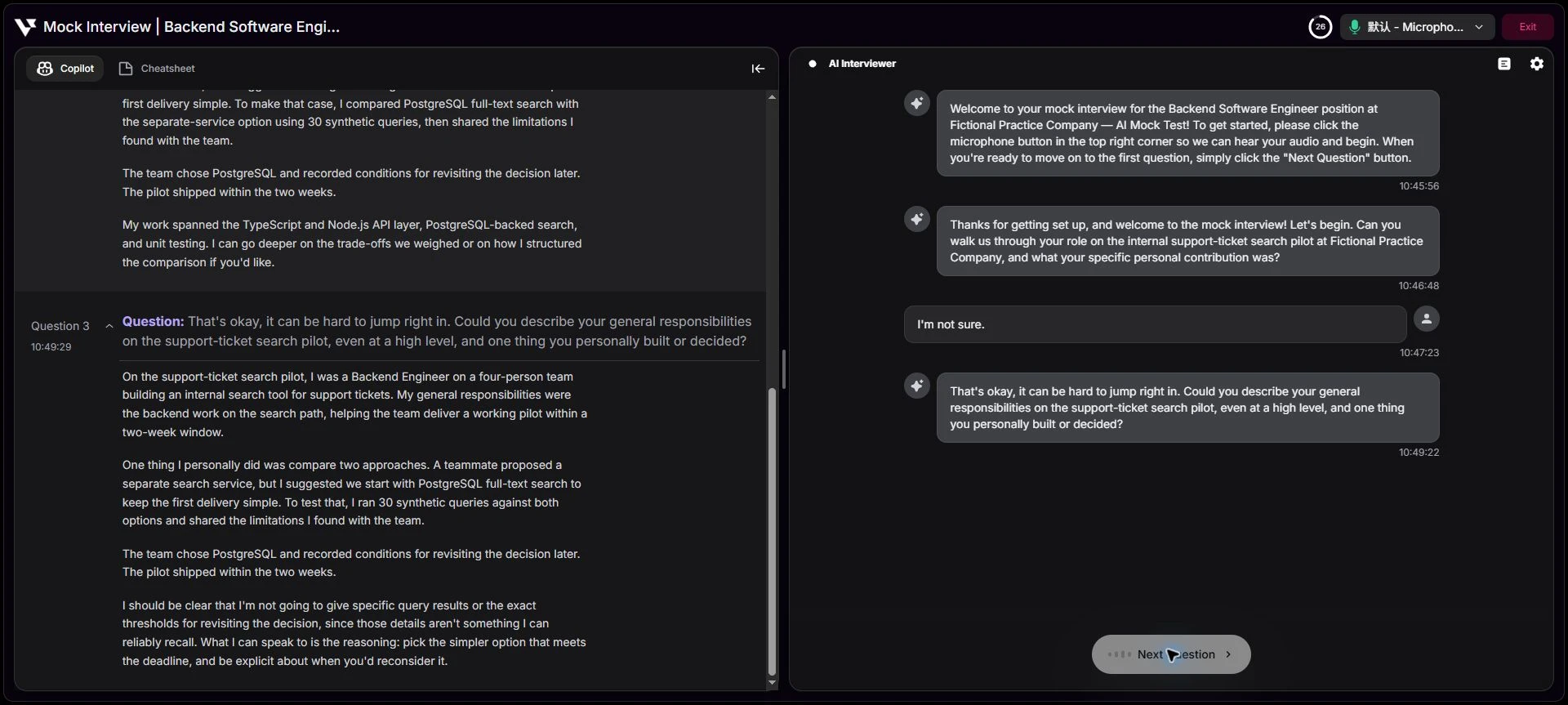
Actual session, October 13, 2026. Interviewer messages and captured speech are separate from AI-generated suggestions. A suggested answer is not evidence that the candidate spoke it. Open full-size screenshot.
The report could only assess what was captured
The user confirmed reading a longer prepared fictional answer aloud, but the visible session and final report did not contain it. The report displayed 1.7/10 and explicitly said the candidate input was too sparse for a meaningful evaluation. We cannot determine from this record whether the cause was the device, microphone placement, configuration or transcription processing.
That score is not a rating of Verve, the user or the complete prepared answer. Without a raw audio recording and a full captured transcript, it also cannot establish transcription accuracy or response latency.
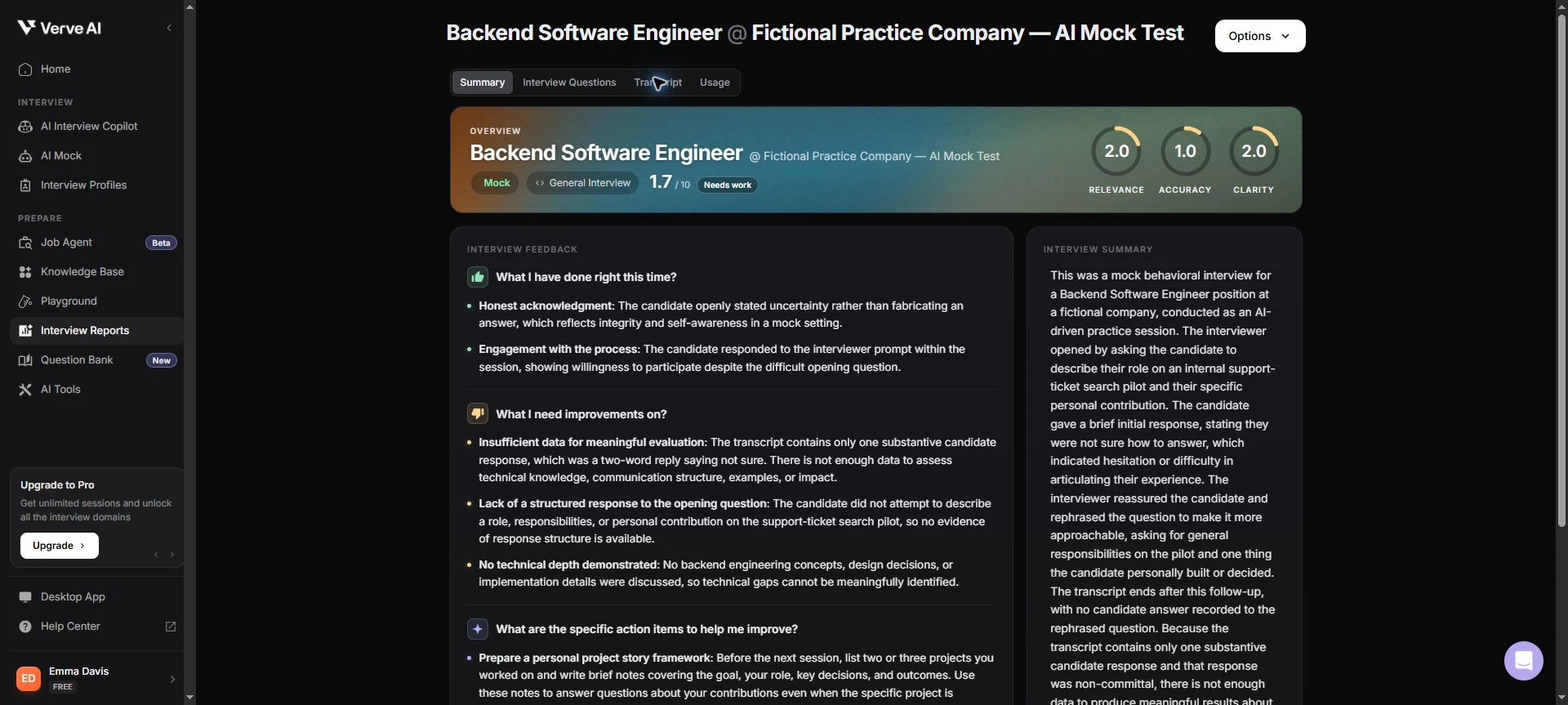
Actual incomplete-input report, October 13, 2026. Read the data limitation alongside the score. Open full-size screenshot.
Before treating any mock score as useful coaching, inspect its transcript. Did it capture the answer you intended to give? If a project detail is missing, a low relevance score may tell you more about the available input than your interview readiness.
A fluent suggestion still needs a factual check
The same session displayed a suggested answer in a Copilot side panel. Parts reflected the fictional resume, but the suggestion also assigned API-layer and unit-testing responsibilities that the supplied project description had not explicitly established as personal contributions.
Use that output as a draft. Check every claim about what you built, led or measured, and remove details you cannot explain under follow-up. Smooth phrasing is helpful only when it stays within your actual experience. Our Copilot versus mock interview guide explains the difference between a suggested response and evidence of independent performance.
Current features: what is documented and what remains untested
Verve's current pricing page describes live transcription, contextual answers, screen capture, session sharing, custom prompts and specialized interview domains. The page also lists Transparent UI, Camouflage mode, screen drag to capture, a question bank, 20 interview domains and a choice of AI models, some of which are paid add-ons on certain plans. Desktop and browser access are different delivery options; a feature available in the desktop app is not necessarily available in every browser workflow.
| Need | What to check | Evidence in this review |
|---|---|---|
| Resume-based behavioral practice | Whether questions use your background and feedback reflects the full answer | Limited October 13 observation; complete-answer evaluation inconclusive |
| Live interview assistance | Audio capture, question detection and readable suggestions in your exact meeting setup | Current documentation reviewed; live performance not measured |
| Coding preparation | Correctness, edge cases and explanation of a screen-captured problem | Advertised capability; no coding benchmark here |
| Model or specialist-domain choice | Availability in your selected plan and any extra credit/add-on cost | Pricing page lists plan and add-on differences; not every model independently tested |
| Cross-device use | Which features work on the client you intend to use | Platform descriptions do not prove feature parity |
| Transparent UI and Camouflage mode | How the overlay behaves in your exact meeting and screen-sharing setup | Advertised, not tested |
| 20 interview domains and question bank | Whether your role and interview type are covered in useful depth | Advertised, not tested |
The October 14 product update says Verve improved when answers begin, handling of long coding responses and some audio notices. An earlier October 11 entry describes Manual, Auto and Smart Listening response modes. These are vendor-reported changes, not performance results from this review. Our older mock record should not be used to declare those changes effective or ineffective.
Desktop visibility and refunds deserve a separate check
Verve's Stealth Mode documentation limits that feature to the desktop application. It also warns that sharing an entire screen from a browser-based meeting may not work as expected. We have not tested those conditions, so this review does not promise invisibility or undetectability. A product's display behavior also does not establish that assistance is permitted in a particular interview.
The refund policy, checked on October 28, lists potential eligibility for verifiable technical problems on Verve's side or a subscription that was not used at all. Requests must be made while subscribed or within five business days after deactivation. Annual early cancellation is not automatically refundable; the same eligibility conditions apply. A request window is not an unconditional money-back guarantee.
Check the selected payment method's renewal terms before purchase. Cancelling future billing, receiving a refund and using remaining subscription time are separate questions.
Try this before paying for more sessions
Use the free allowance for a focused practice check. The exercise below is original fictional material, not an employer interview question or a newly executed test.
Background: A four-person team evaluated two search approaches over two weeks using thirty synthetic support queries. Your contribution was comparing the approaches and documenting why the team chose PostgreSQL. No measured revenue, latency reduction or customer outcome is supplied.
Ask for a question about your personal contribution, give a short spoken answer, then request a follow-up about how the approaches were compared. Check four things:
- Input: Does the visible transcript contain the answer you actually gave? Resolve missing audio before judging feedback.
- Grounding: Does the suggested response preserve your stated contribution without inventing metrics or ownership?
- Follow-up: Does the next question address your answer, or simply restart the topic?
- Feedback: Can each criticism be traced to something in the captured answer, with an actionable revision?
For a reusable comparison checklist, see how to choose an AI interview copilot. Keep notes on your device, input settings and chosen mode. The question is whether the workflow helps you practice and explain your own work. There is no need to exhaust the free allowance before checking whether the first transcript is complete.
Who should pay for Verve AI?
Stay free while you verify the basics. Five mocks and three short Copilot sessions give you an opportunity to check setup and fit. They do not establish that a longer session or every specialist feature will work for you.
Consider Standard for repeated practice and a small session budget. It combines unlimited advertised mocks with five monthly Copilot sessions. Confirm that the separate report allowance meets your needs, Standard already advertises unlimited mocks, so upgrading to Pro for mock practice alone adds little.
Consider Pro for higher session frequency or longer sessions. Its 90-minute per-session allowance and unlimited count address different limits. Compare those needs with the $40 monthly difference, any add-ons and the actual bill you are ready to commit to.
Look elsewhere if the free workflow does not fit your setup. If transcripts remain incomplete after checking settings, you cannot assess feedback meaningfully. If your priority is coding correctness or a particular meeting workflow, test that exact task rather than choosing from a generic feature checklist.
For a desktop alternative, SkillCopilotAI offers interview assistance, mock practice and screenshot-based help, with included models varying by paid tier and a separate 30-minute trial. That is a documented product offer, not evidence that it outperforms Verve. Compare the full terms on our pricing page, or use the Verve AI alternatives comparison if you have already decided to switch.
The cover is an AI-generated editorial illustration, not a Verve interface or test result.
Frequently asked questions
Is Verve AI free?
It has a free plan. The public pricing page lists three 15-minute Copilot sessions and five mock interviews. Those limits are distinct; free access is not unlimited interview assistance.
Is Verve AI Pro $34.99 a month?
That was the displayed annual monthly equivalent on October 28. The month-to-month Pro offer was $84.99. Check billing selection, currency and total payable before comparing prices.
Does Verve AI work for coding interviews?
Verve advertises a Coding Interview Copilot with screen capture and follow-up actions for shared editors such as CoderPad and HackerRank. We did not run a coding test for this review. Use a problem with a known solution and verify the output, edge cases and explanation before relying on it for practice.
What did the mock session prove?
It showed background-aware questioning, a related follow-up and a report after exit. It did not establish accurate evaluation of a complete answer, current-version latency or improved interview outcomes. Start with a free session and check the input your report actually received before deciding what the feedback is worth.
Compare similar tools
Editor selected
InterviewMan Review 2026: Hands-On Test, Pricing & Drawbacks
Is InterviewMan worth $30 a month? Our hands-on browser test covers answer quality, technical follow-ups, pricing, limitations, and who should try it.
Editor selected
Interview Sidekick Review: Pricing, Free Trial, and Alternatives
Interview Sidekick pricing, two-minute free sessions, and a Windows desktop trial: resume accuracy, follow-ups, coding answers, and alternatives.
Editor selected
ShadeCoder Review: Pricing, Features & Trial Checks
ShadeCoder review covering paid features, pricing, free-credit limits, and who should try it. Includes an original coding check and clearly stated research limits.
Editor selected
Cluely AI Review 2026: Features, Pricing, Privacy, and Verdict
Is Cluely worth it? This research-based review examines its live meeting features, current pricing, privacy terms, limitations, and best-fit users.
Choose your next step
Compare another tool or move from research into structured interview practice.