


Netflix's October 2026 layoffs affect roughly 1,000 positions, according to reporting published on October 14. If you are looking for the latest facts, the summary below explains the reported scale and affected departments. If your role has been eliminated, the rest of this guide focuses on a more immediate task: explaining the transition and preparing to discuss your work in your next interview.
The news summary was checked on October 15, 2026. The interview examples are fictional practice material, not accounts from Netflix employees or questions from Netflix's hiring process.
Cover: AI-generated illustration of a fictional job seeker.
What Happened in the October 2026 Netflix Layoffs?
The Associated Press reported on October 14 that Netflix planned to cut about 6% of its workforce, nearly 1,000 positions. The report identified product, technology, legal and human resources as the departments most affected, citing a memo from the company's co-CEOs.
- Announcement reported: October 14, 2026.
- Reported scale: About 6% of the workforce, nearly 1,000 positions.
- Most affected departments: Product, technology, legal and human resources.
- Scope of this guide: The October announcement and preparation for a subsequent job interview.
Those are company-wide figures. They do not establish why an individual role was selected, what any particular employee was told, or whether a specific vacancy remains open. Use your own employment documents and direct communications for questions about your position.
This article covers the October announcement rather than presenting a cumulative count of every Netflix job reduction in 2026.
What Does the News Mean for Your Job Search?
If you were affected, you do not need to explain Netflix's entire business strategy to a future employer. You need a truthful account of your departure, relevant examples of your work, and a reason the next role interests you.
If you are applying to Netflix, the announcement alone does not tell you the status of your application. Check the specific posting and ask your recruiting contact whether the team is still hiring. Avoid interpreting a company-wide reduction as proof that every team has stopped recruiting.
For either situation, start with one target role. Read its responsibilities and identify three areas where your experience provides evidence. Preparing around a real job description gives your practice a purpose beyond retelling the news.
How to Explain a Layoff in an Interview
Prepare a brief answer to “Why did you leave your last role?” State what happened, summarize your responsibilities, and connect that experience to the opportunity in front of you.
Fictional engineering example — adapt only if the facts match your experience:
“My role was eliminated during a company restructuring. I worked on backend services, particularly reliability and incident response. I'm now looking for a role where I can take more ownership of distributed systems, which is what interested me in this position.”
The answer gives context without making the whole conversation about the departure. It also introduces a topic the interviewer can explore: your reliability work.
Fictional product example:
“My position was eliminated as part of a restructuring. My recent work focused on prioritizing improvements to an onboarding flow and coordinating their delivery with engineering and design. I'm looking for a role with similar cross-functional ownership, and your team's focus on activation caught my attention.”
Do not add “it wasn't performance-related” unless you have a factual basis for saying so. Likewise, do not invent a team closure or imply that everyone in your department was affected. A shorter answer is useful only if it remains accurate.
Practice the explanation aloud, then stop. You can acknowledge that the transition was difficult without supplying a long account of internal discussions. Let the interviewer ask for any additional context they need.
Prepare the Follow-Up, Not Just the Departure Explanation
The next question may be about the work you just mentioned. A polished departure explanation will not help much if you cannot describe your contribution.
Choose one project and make a five-line note:
- The problem your team needed to solve.
- The responsibility you personally held.
- A decision you made and the alternative you considered.
- The outcome you can accurately describe.
- What you would change if you did the work again.
For the engineering example, rehearse these original practice questions:
- What made the service unreliable?
- Which part of the investigation did you own?
- Why did you choose that fix over another approach?
- How did you determine whether the fix helped?
For the product example, try these:
- What evidence suggested the onboarding flow needed attention?
- What did you decide to prioritize, and what did you defer?
- How did you handle disagreement with engineering or design?
- What did the result teach you?
If you cannot share a metric, explain the observable outcome without fabricating a number. Keep confidential implementation details, customer information and internal documents out of your practice materials.
A Three-Question Practice Example in SkillCopilotAI
A reader supplied the three screen photos below from a simulated SkillCopilotAI session. The fictional profile described a backend engineer with four years of experience in APIs, service reliability and incident response, whose position was eliminated during a restructuring in October 2026. This was not a Netflix interview or an account from a Netflix employee. SkillCopilotAI publishes this guide; Emma edited the article and did not conduct this session.
The photos show generated answer suggestions, not feedback on a candidate's own spoken answers. They have been cropped to remove surrounding webpage content; the displayed response text has not been altered. Only the visible portions are assessed here.
On a phone, use the full-size photo links to inspect the response text. The observations below also explain each result without requiring you to read small text in the images. The product version, model and full session configuration were not recorded, so this is a limited example rather than a reproducible benchmark.
Question 1: Why Did You Leave Your Previous Role?
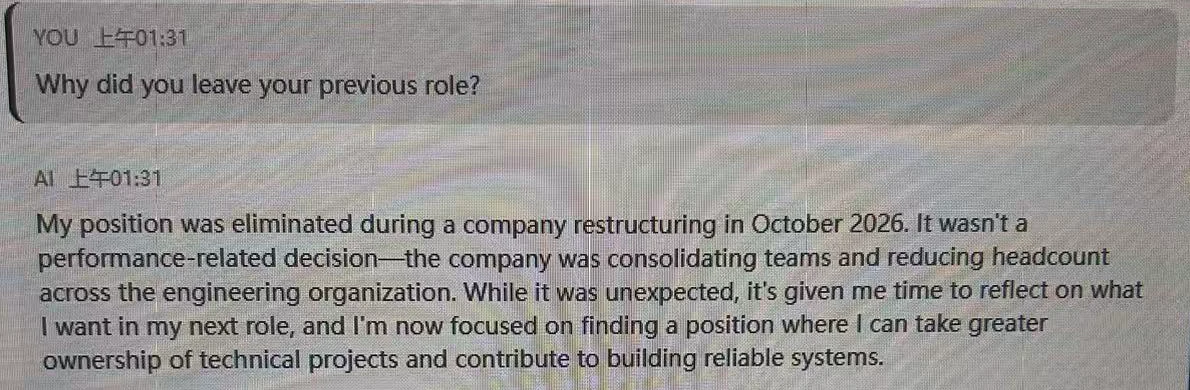
View the full-size question 1 photo.
User-supplied photo of fictional interview practice, cropped to the question and answer.
The suggestion explains the restructuring and connects it to the candidate's interest in technical ownership. However, it adds that the decision was not performance-related and that engineering teams were being consolidated. Those details were not supplied in the practice profile. Keep that wording only if it is true for your own situation.
An editorial revision using only the supplied facts:
“My position was eliminated during a company restructuring in October 2026. In that role, I worked on backend APIs, service reliability and incident response. I'm now looking for a backend engineering role where I can help build reliable services and take greater ownership of technical projects.”
This revision removes the unsupported explanation of why the role was selected. It is an example edited for this guide, not a second response captured in the session.
Question 2: Give an Example of Improving Service Reliability
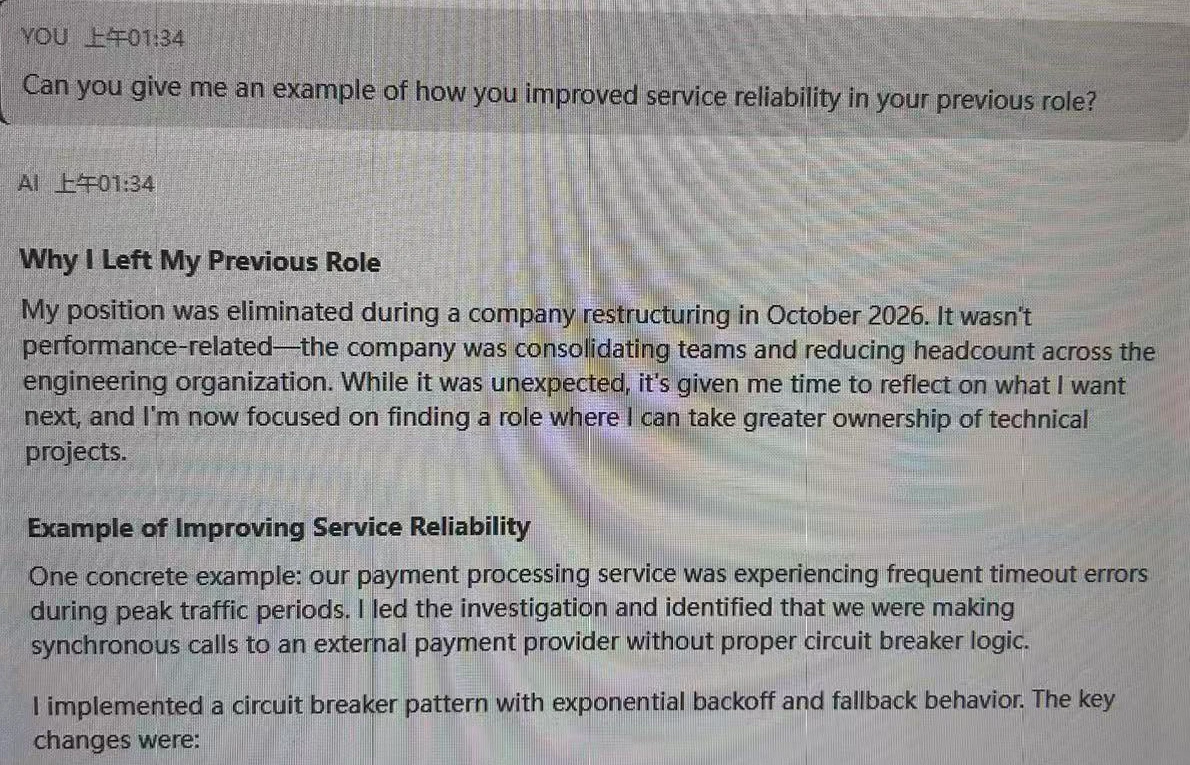
View the full-size question 2 photo.
Visible response excerpt; the original photo did not show the entire answer.
The user asked, “Can you give me an example of how you improved service reliability in your previous role?” The visible suggestion describes payment timeouts and a circuit breaker approach. It gives a concrete project narrative, but the payment service and implementation details were generated rather than provided in the profile. It also repeats the departure explanation before addressing the new question.
Use the structure to organize a real project. Replace the generated project details with your actual problem, contribution and reasoning.
Question 3: How Did You Measure the Improvement?
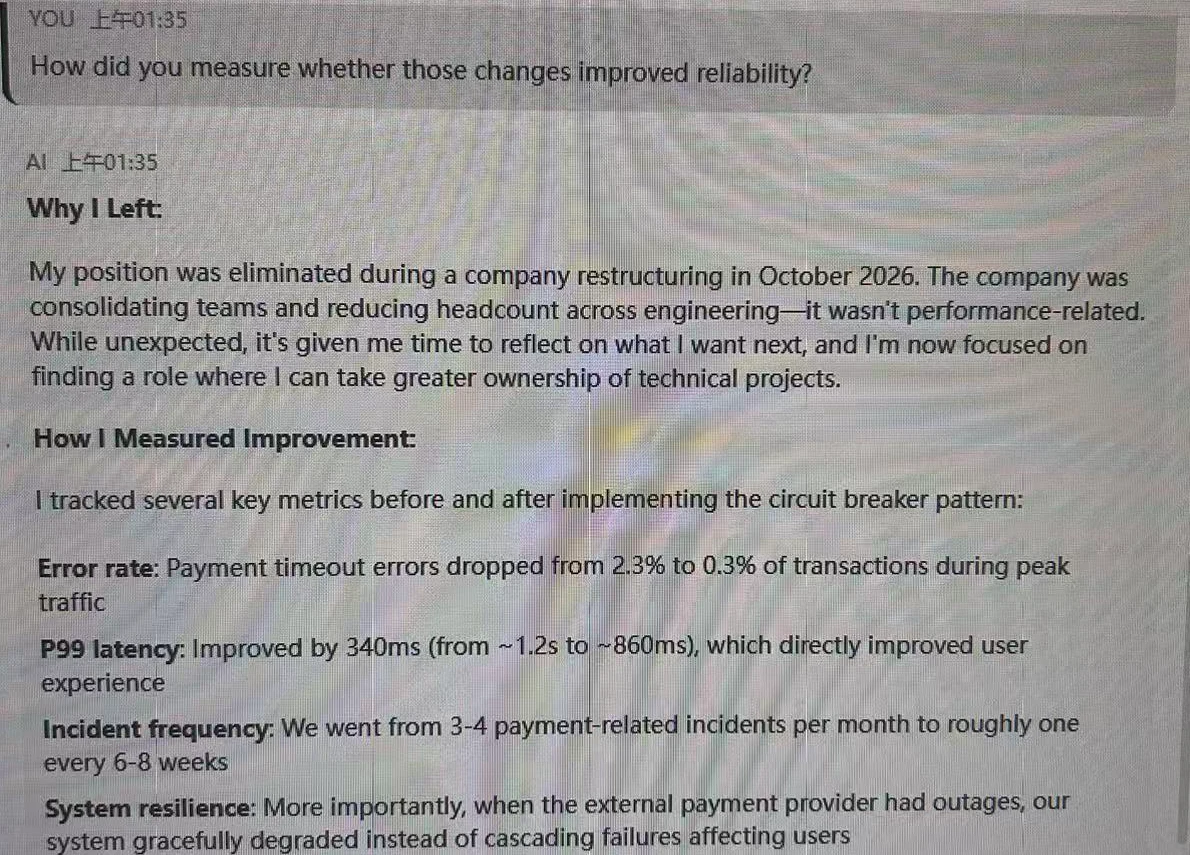
View the full-size question 3 photo.
Generated metrics in a fictional practice response; these are not measured product results or verified candidate achievements.
The follow-up asks how the changes improved reliability. The suggestion names relevant dimensions: error rate, P99 latency, incident frequency and behavior during provider outages. It also supplies exact figures, including a timeout rate falling from 2.3% to 0.3%. No such measurements were provided in the practice profile.
Before using a metric in your own answer, fill in these five items from evidence you are allowed to discuss:
- Metric: What did you measure, and how was it defined?
- Baseline: What was the value before the change?
- After the change: What value did you observe afterward?
- Comparison period: Were the time windows and traffic conditions comparable?
- Evidence source: Which monitoring report or test supports the claim?
If you do not have the measurements, describe the monitoring approach or a verified qualitative outcome. Do not substitute the numbers shown in the fictional response.
This sequence shows answer suggestions extending across two follow-ups. It also shows why factual review matters: a useful answer structure can contain unsupported project details and numbers. Keep only claims you can explain and substantiate, and remove repeated background when answering a new question. These photos do not establish hiring outcomes, response speed or accuracy across other sessions.
A Focused Three-Session Preparation Plan
You can use the following sessions as a starting point. The schedule is an editorial exercise, not a Netflix interview requirement.
Session 1: Explain the Transition
Write your departure explanation and a short introduction tailored to one job description. Answer both aloud without reading a full script. Listen for unsupported claims, unnecessary background and a missing connection to the target role.
Repeat the weaker answer once. Keep factual bullet points rather than memorizing every sentence.
Session 2: Rebuild Your Project Stories
Prepare two real examples: one showing a useful result and one showing a difficult decision or setback. For each, distinguish your actions from the team's work.
Ask a practice partner to interrupt with “What did you do personally?” and “Why did you choose that approach?” If you struggle, add the missing evidence to your outline before repeating it.
Session 3: Rehearse for the Actual Role
Use the job description to select behavioral and role-specific questions. Include your introduction, departure explanation, two project stories and questions you want to ask the employer.
The University of Michigan Career Center's interviewing resources recommend rehearsing with others or recording yourself, and using bullet points rather than memorized scripts. Its guidance also describes using AI to generate practice questions from a job description.
After the rehearsal, review three things: whether you answered the question, made your contribution clear, and supported your claims. Choose one answer to improve instead of rewriting everything.
For a longer routine, follow our seven-day AI mock interview practice guide, which includes a reusable review scorecard.
Use AI Practice to Check Your Answers
Start with an unaided answer. You need to know what you can explain independently before comparing it with suggested wording.
Here is a practice prompt you can use with an AI tool:
“Act as an interviewer for the role described below. Ask why I left my previous job, then ask two follow-up questions about my project experience. Ask one question at a time. After I answer, identify unclear wording and unsupported claims. Do not invent achievements, results or reasons for my departure.”
Supply a sanitized job description and your own factual notes. Treat feedback as a suggestion to review, not proof that your answer is accurate or that an employer will respond favorably.
Our AI interview copilot selection guide offers a checklist for evaluating tools in a rehearsal. If you decide to try SkillCopilotAI, use the download page and compare your practiced answer with your original unaided attempt. Make sure you can explain every claim in your own words.
Your departure is one part of the conversation. The preparation that follows should make the rest easier: what you worked on, how you made decisions, and why your experience fits the next role.
Continue preparing
Same content type
Best AI Interview Practice Tools 2026: How to Choose and Use Them Ethically
Compare AI interview practice tools in 2026 and learn how to use them ethically for coding, behavioral, system design, and technical interview preparation.
Same content type
Can AI Listen to Interview Questions and Suggest Answers?
Learn how real-time AI interview assistants listen to questions and suggest answers, their accuracy and privacy limits, and when live use may be permitted.
Same content type
IBM Competency Interview Questions & STAR Answer Examples
Prepare for your IBM competency interview with original practice questions, three annotated STAR answers, a fillable story worksheet, and a recording checklist.
Useful next step
Interview Sidekick Review: Pricing, Free Trial, and Alternatives
Interview Sidekick pricing, two-minute free sessions, and a Windows desktop trial: resume accuracy, follow-ups, coding answers, and alternatives.
Ready to ace your next technical interview?
Join thousands of candidates who landed their dream jobs with SkillCopilotAI.