

Start with ShadeCoder if you want to try AI answers before paying or need a lower short-term bill. Consider Interview Coder if its documented audio workflow and broader interview coverage fit your preparation, and you accept the higher entry price. Neither is a demonstrated accuracy or speed winner in this comparison.
This research-based Interview Coder vs ShadeCoder comparison checks public sources on November 12, 2026. We have not run either desktop app. SkillCopilotAI, the publisher, makes a competing assistant; its relevant phone-sharing workflow appears after the A/B comparison.
The cover is an AI-generated editorial illustration, not a product screen or a photograph of a test.
Interview Coder vs ShadeCoder at a glance
| Decision | Interview Coder | ShadeCoder | What it means for you |
|---|---|---|---|
| Try an AI answer free | Free installer; AI features require payment | Five signup credits described in its pricing FAQ | ShadeCoder offers a way to inspect an answer before buying; verify the account allowance |
| One month | $299 with 1,000 usage credits | $69 with unlimited credits advertised | Compare the bill and allowance separately; credits are not standardized across tools |
| Shorter access | No weekly offer shown on the homepage checked | $39 per week | One week costs less upfront; two weekly payments exceed its monthly price |
| Lifetime offer | $799 once; unlimited access advertised | $699 once; unlimited credits advertised | Both require a much larger initial payment than short access |
| Spoken questions | Official FAQ explains real-time audio transcription | Paid pricing lists transcription; older terms contradict it | Interview Coder documents the workflow more clearly; confirm ShadeCoder's current audio behavior |
| Desktop availability | Mac and Windows downloads | Mac and Windows downloads | Test your exact machine, permissions and meeting setup |
Sources: Interview Coder product, plans and FAQ and ShadeCoder's current pricing and FAQ. Listed prices are in US dollars; these are public offers, not completed checkout totals.
Pricing: compare the payment for the time you need
For a short preparation period, ShadeCoder has the smaller listed bill. Its weekly plan costs $39, while monthly costs $69. Two weekly payments total $78, so monthly is $9 less if you expect to need a second week. Check the access dates and renewal settings before choosing.
Interview Coder lists $299 per month and $799 once. Its monthly allowance is 1,000 usage credits; lifetime advertises unlimited access. That does not tell us how many complete problems, retries and spoken follow-ups a monthly account can handle. Confirm what consumes a credit before estimating capacity.
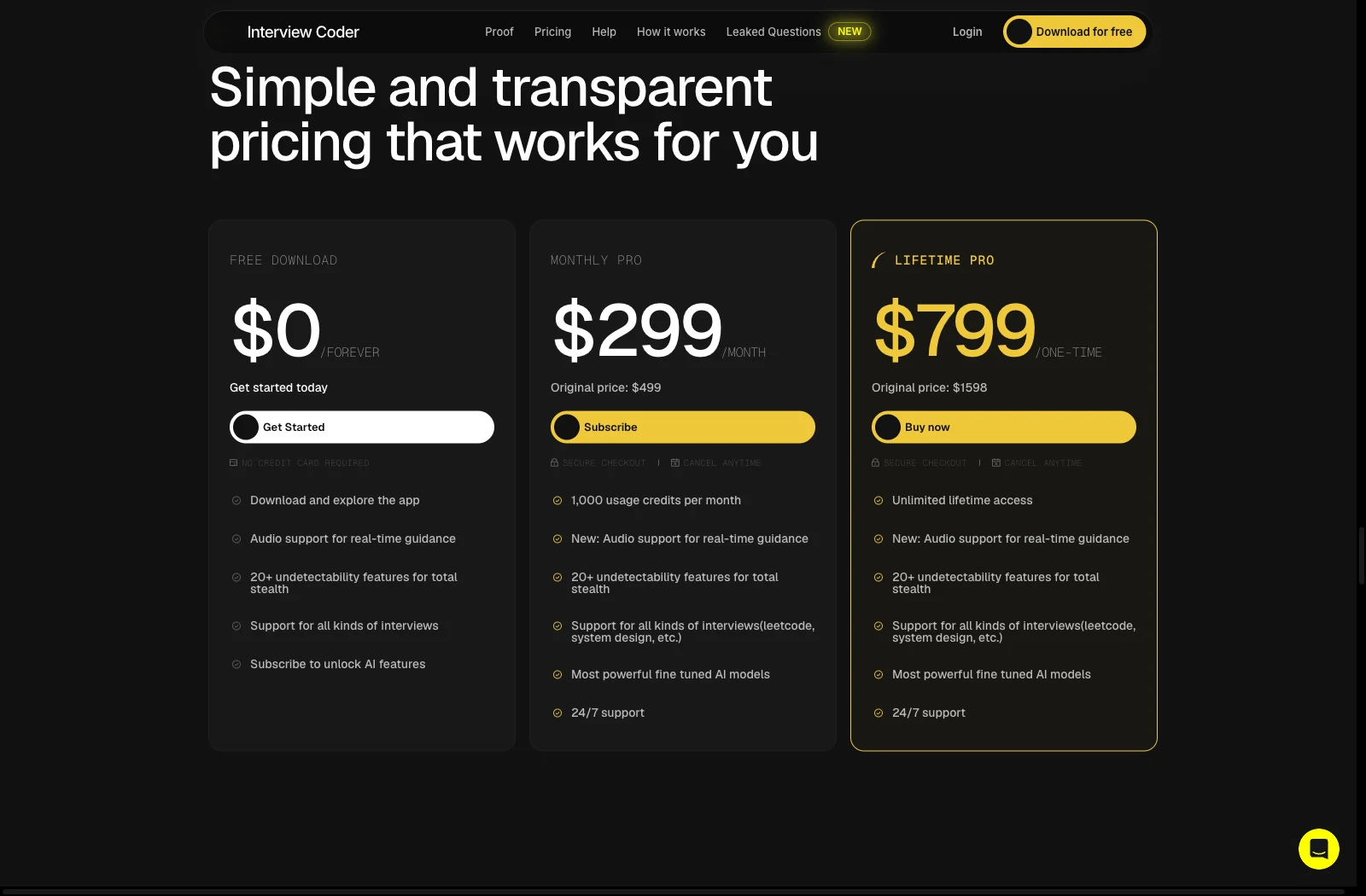
Interview Coder's official homepage, captured November 12, 2026. The free card distinguishes exploring the app from unlocking AI. Open the full-size capture.
ShadeCoder lists $699 once for lifetime access. At the displayed monthly rates, three Interview Coder monthly payments total $897, and eleven ShadeCoder monthly payments total $759. Those totals exceed each tool's own lifetime price, but only matter if you would otherwise keep paying that long. They do not establish code quality or guarantee future service.
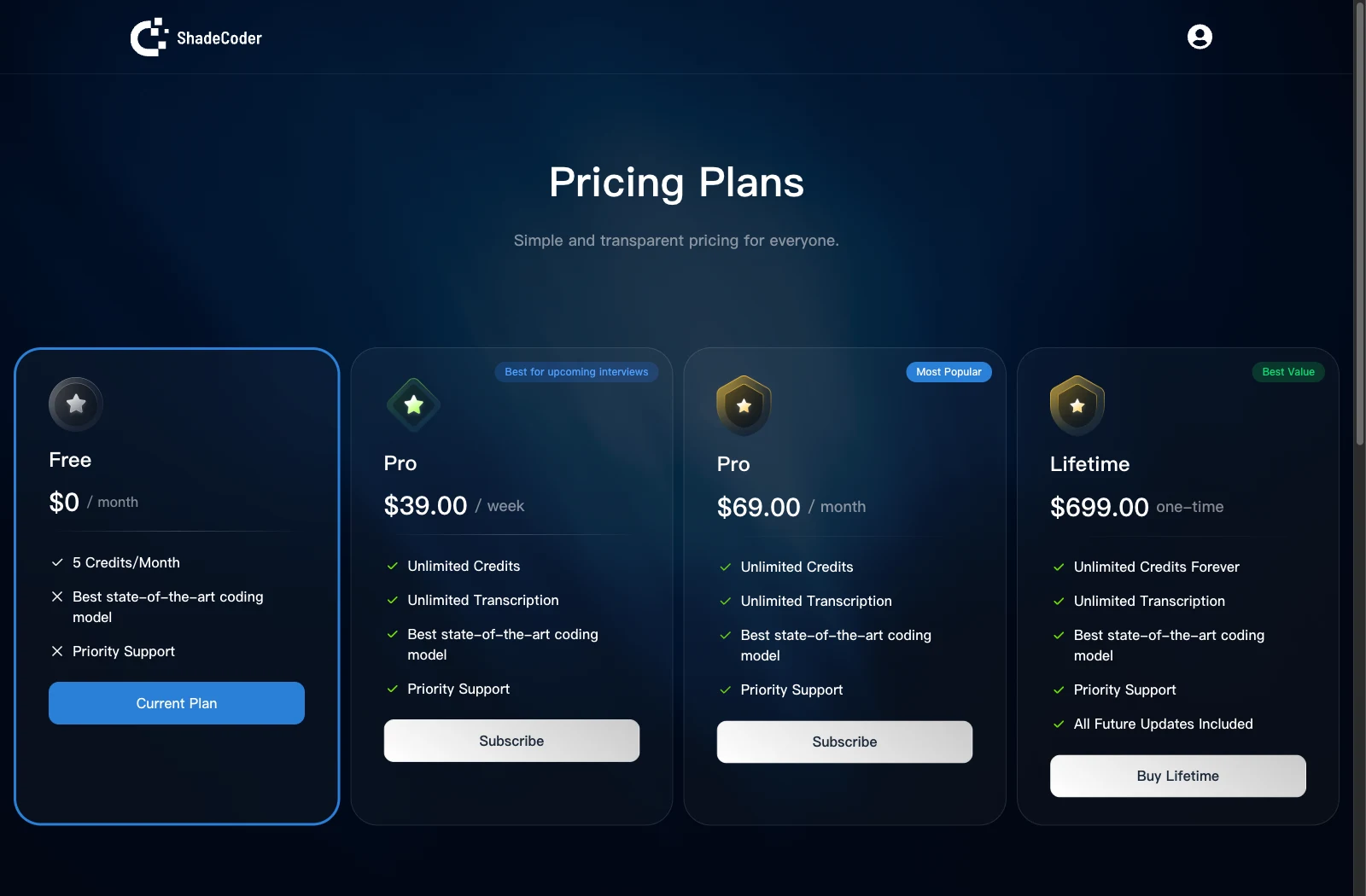
ShadeCoder's live pricing page, captured November 12, 2026. Paid cards advertise unlimited credits and transcription. Open the full-size capture.
If you already own a lifetime license that meets your needs, another subscription adds a new bill. Identify the particular input or follow-up problem you want to fix before switching.
Free access and refund terms need a closer look
Interview Coder's free download does not include AI answers, according to its FAQ. You can inspect the app, but that is a limited basis for judging generated code before paying.
ShadeCoder's pricing FAQ says new accounts receive five credits to try AI. Its card says five credits per month, while the FAQ describes signup credits followed by paid access. The Free card also excludes the advertised advanced coding model, despite the FAQ describing access to the full experience. Verify renewal and model access in your account rather than planning repeated trials around an uncertain allowance.
Both publish a no-refund statement: Interview Coder's policy and ShadeCoder's pricing FAQ. Interview Coder's policy describes lifetime-only sales even though its homepage offers monthly billing. Confirm the cancellation procedure for the monthly purchase you are considering. ShadeCoder explicitly includes weekly, monthly and lifetime purchases in its pricing FAQ's no-refund statement.
Check how each tool receives the question
A coding prompt can include a diagram, a function signature and constraints below the fold. Capture those together before comparing answers. Otherwise, one assistant may receive a complete task while the other has to guess a missing rule.
ShadeCoder's product page describes global hotkeys, screenshot and diagram input, structured solutions and interactive follow-ups. Try that workflow if you prefer to decide when the assistant receives the problem. Check whether the explanation gives you enough detail to trace the algorithm yourself.
Interview Coder's current FAQ describes transcribing spoken questions in real time. Its homepage also advertises system-design and behavioral coverage. Calling it a coding-only product would misstate its current offer. Try a system-design or behavioral question from your own preparation before relying on that broader coverage.
If spoken follow-ups are essential
ShadeCoder's paid pricing advertises transcription, but its terms dated February 14, 2025 say it does not process audio. Those terms also retain a $29 monthly price. We cannot establish which audio description matches the current app from these conflicting pages.
Before paying for an audio-dependent workflow, confirm the current version, supported audio source and included allowance, then try a spoken correction during practice. Interview Coder's clearer audio documentation makes it a candidate for that task; it does not prove better transcription or faster answers.
Check your computer and meeting setup
Both vendors provide Mac and Windows downloads. ShadeCoder's setup guide recommends checking compatibility before upgrading. Its homepage's top Windows download currently names version 3.0.3, while a lower Windows link names 3.0.0. Verify the version you install.
For either tool, check capture permissions, the entire question, your programming language and a follow-up on your own machine. Screen-share visibility and visibility in a process list are different properties. We have not tested either, and vendor claims do not establish permission to use assistance in an assessment. Use a mock session or another setting where assistance is allowed.
Compare code with the same problem and one changed rule
We found no reliable, reproducible matched test that establishes an accuracy winner for these two products. You can use this original exercise to check an answer and a follow-up yourself. It is not an employer question or output produced by either assistant.
Supply the same complete prompt to each tool:
Implement merge_intervals(intervals) in Python 3.
Each interval has integer endpoints start < end.
Input may be unsorted and contain duplicates.
Return sorted merged intervals without changing the input.
Initially, use closed intervals: touching endpoints count as overlap.
Explain the algorithm and its time and space complexity.

Input: [[5, 7], [1, 3], [3, 5], [2, 4], [9, 10], [9, 10]]
The expected output is [[1, 7], [9, 10]]. A sort-and-scan solution should take O(n log n) time. Also check empty input and [[1, 2], [2, 3]], which should produce [[1, 3]] under this rule.
Now change only the boundary rule:
Treat every interval as half-open,
[start, end). Merge only intervals with a nonempty intersection. Keep the original input and other requirements. Explain the smallest code change and recalculate the result.
The main example becomes [[1, 5], [5, 7], [9, 10]]. The two-interval check becomes [[1, 2], [2, 3]]. A scan that previously merged when the next start was <= the current end must now use <.
Record the unedited code, executed output, explanation and any capture correction. If the explanation adopts the new rule but the code keeps <=, record a failed follow-up. For an audio comparison, speak the same correction and first verify that it was transcribed correctly. Keep the device, language and question constant, and note plan or model differences you cannot align.
Our reference scan was checked against an independent graph-based implementation across 7,752 interval-set and boundary combinations. That validates the exercise within the checked domain, not either product. One successful exercise is useful trial evidence, not a general accuracy measurement. Our ShadeCoder review provides another boundary-change exercise.
When SkillCopilotAI belongs in your shortlist
Consider SkillCopilotAI if you want to keep coding on the desktop and use your phone to read answers or send follow-ups. Its mobile-sharing description covers live answers in a phone browser, requests for desktop screenshots and typed questions sent to the current AI model.
The desktop app must remain running. Remote screenshots must be allowed there and follow its capture settings; the phone is not an independent coding assistant. We have not verified an equivalent workflow in either competitor, so this is a reason to evaluate SkillCopilotAI, not a claim that they lack it.
The current pricing page advertises a 60-minute trial with limited model access and a $48 Pro monthly subscription with unlimited core coding assistance and screenshots during the paid term. Pro is $21 below ShadeCoder's captured $69 monthly offer; Elite at $98 is $29 above it. Compare the included models and test the phone controls before deciding.
Download the installer for Windows 10/11 x64 or macOS 14+, then sign in from the app to authorize it. Prepare the interval exercise first. In the trial, check that the complete prompt reaches the desktop session, the answer appears on your phone and the changed rule reaches the same conversation. Inspect the resulting code separately from whether sharing worked. This article does not report a completed phone-and-desktop test.
SkillCopilotAI plans (updated November 19, 2026): Pro is $48 monthly, $114 per quarter ($38/month) or $336 per year ($28/month). Elite is $98 monthly, $234 per quarter ($78/month) or $696 per year ($58/month). Entry-price comparisons refer to Pro unless marked Elite. Included models depend on both your tier and billing period; compare the actual model list on the pricing page.
For more detail on the desktop coding workflow, see Interview Coder alternatives. The SkillCopilotAI coding workflow explains its problem-breakdown and debugging use cases.
Questions before you choose
Is ShadeCoder cheaper than Interview Coder?
At the public prices checked, yes: $69 versus $299 monthly, and $699 versus $799 for lifetime. ShadeCoder also offers $39 weekly. Compare the same duration and verify what your chosen allowance covers; a smaller bill does not establish better answers.
Which should I try first?
For a short coding-preparation period and a chance to inspect AI output before purchasing, start by checking ShadeCoder's free credits. If real-time spoken input or Interview Coder's broader advertised round coverage is central to your choice, evaluate that documented workflow and resolve the paid-access commitment first. Hold off on either lifetime purchase until you know the workflow fits.
Which is better at difficult coding questions?
This research does not establish that. Compare complete inputs, executable code and changed requirements under documented conditions. Neither price, a model label nor an offer-letter testimonial substitutes for those results. If you need to evaluate more tools, use the same conditions with our interview copilot selection checklist.
For the single-product buying decision, our Interview Coder review examines device-specific audio limits, free compatibility checks and the questions to resolve before paying.
Sources and comparison method
The linked official product, pricing, FAQ, setup and policy pages were checked November 12, 2026. They support published capabilities and purchase conditions. Pricing screenshots record visible offers; we did not complete checkout or measure desktop accuracy, response time, audio quality or screen-sharing behavior.
Emma's byline identifies article editing and website operations, not a claim of product testing. This article was prepared with AI assistance and source checks. The interval exercise is original editorial material with a checked reference implementation. Recommendations follow the documented input needs, trial access and payment commitment; the competing publisher's interest is disclosed above.
Compare similar tools
Editor selected
Best Interview Coder Alternative: SkillCopilotAI Trial & Pricing
Compare Interview Coder and SkillCopilotAI on free AI access, screenshot-based coding, monthly costs, and lifetime versus subscription billing.
Editor selected
ShadeCoder Review: Pricing, Features & Trial Checks
ShadeCoder review covering paid features, pricing, free-credit limits, and who should try it. Includes an original coding check and clearly stated research limits.
Editor selected
Final Round AI vs LockedIn AI: Plans, Trials & Client Fit
Compare Final Round AI vs LockedIn AI on coding inputs, desktop and mobile clients, billing commitments and usable free access before choosing.
Same content type
Beyz AI Alternative: Coding, Phone Sharing and Input Fit
Compare Beyz AI with SkillCopilotAI by coding access, context files, phone workflow and full billing costs. Check whether to upgrade Beyz or switch.
Choose your next step
Compare another tool or move from research into structured interview practice.