

Choose Cluely when you already have a preparation routine and want on-demand help, transcripts and notes across everyday meetings. Choose Final Round AI when you want a more structured interview workflow: role-specific practice, live guidance, screen help and a debrief that informs your next attempt. That is the clearest difference in their current documentation. It does not establish which one gives better answers under pressure.
A useful comparison needs to follow the answer beyond its first sentence. If the interviewer changes a condition, you need to notice it, adjust the reasoning and keep explaining. A live suggestion can supply a starting point, but a long paragraph can also leave you reading while the conversation moves on.
SkillCopilotAI is relevant here too. Our AI interview assistant describes concise guidance using resume and role context, alongside coding and screenshot assistance. Its 60-minute trial gives new users a way to check that combination before subscribing. Below, I explain a specific spoken-to-code task to try, as well as the trial's continuous timer.
Method: I checked public product, documentation and pricing pages on November 25, 2026. This is a research-based comparison with an original editorial practice example, not a completed side-by-side product test. SkillCopilotAI makes a competing assistant. Use the exercises in private practice or where assistance is permitted.
Cluely vs Final Round AI at a glance
| What you need | Cluely's documented workflow | Final Round AI's documented workflow | What the difference means |
|---|---|---|---|
| Help during a conversation | Live transcript, dynamic questions and answers on a click or shortcut | CoPilot recognizes interview questions and suggests contextual answers | Decide whether selecting a prompt fits your attention, or whether you want interview-focused guidance |
| Your background in the answer | Custom instructions and file uploads | A Goal with resume, target role, job description and materials | Both accept context; neither label proves the answer preserves your actual contribution |
| Rehearsal before the call | Meeting-oriented help; the inspected pages do not document a dedicated mock interview loop | Spoken practice across eight named scenarios | Final Round is the more explicit fit for someone who needs repeated interview practice |
| A question shown on screen | Get Answer for screen content; Smart Mode for coding assistance | Screen Help with Auto-capture and Solve screen | Both document visual input; compare how they handle a changed requirement, not merely whether they take a screenshot |
| Review afterward | Meeting notes, recap and questions about past meetings | Automatic Interview Debrief with areas to improve | A record helps recall; coaching feedback needs to identify what to change next time |
| Free access to evaluate | Starter includes limited AI answers and meeting notes | Free setup/preparation; live sessions require Pro | A free account does not give the same evaluation opportunity in both products |
Where SkillCopilotAI fits before you commit
The useful reason to try our tool is the transition between explaining a project and working through its technical details. An interview may start with “How did you handle payment retries?” and then turn into a screen full of duplicated events. Context helps with the first part; a screenshot supplies details that were never spoken aloud in the second.
SkillCopilotAI's published workflow combines resume, role, company and interview-type context with a concise response outline. Coding Copilot describes prompt parsing, edge cases, complexity, debugging and explanation support. For this comparison, that means you can evaluate whether the same assistant helps you keep your story accurate and then reason about the implementation. Those are capabilities and a proposed use, not a claim that it outperforms either competitor.
Keep the question on the computer and the answer on your phone
With Mobile Mirror, SkillCopilotAI can show answers from the running desktop session in a phone browser. You can keep the question and editor on the computer while reading the response on your phone, or leave the desktop answer window open and use both displays. The phone can also send a typed follow-up to the same session. Desktop screenshot requests require permission in the desktop app and follow its capture settings.
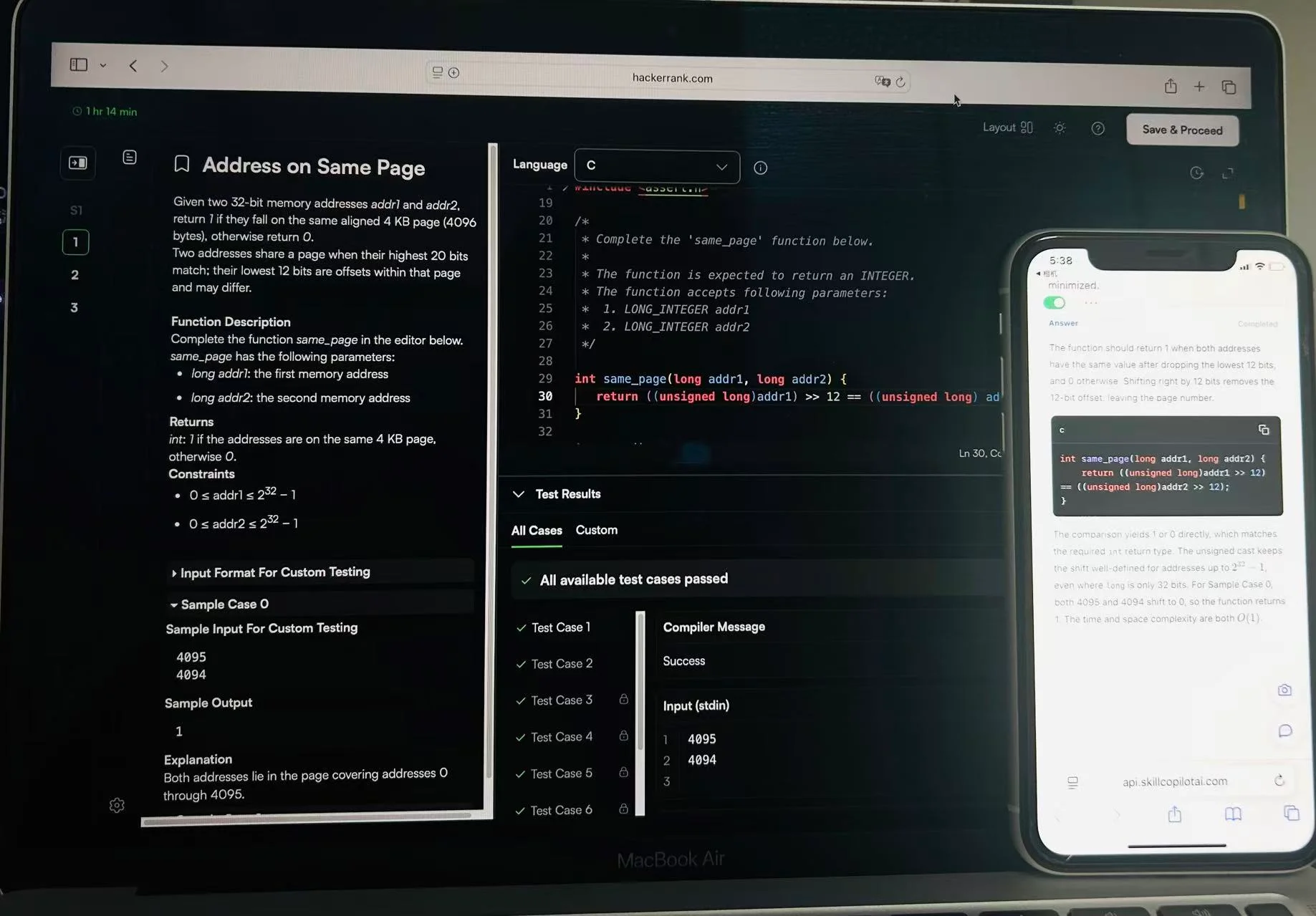
Computer and phone display arrangement, reused from our NVIDIA Ignite article. The phone shows a solution and explanation beside the computer's coding screen. This is a separate example, not the payment exercise or a Cluely–Final Round comparison result. Tap the photo to open it at full size.
For the payment exercise below, this lets you read the guidance on the phone while checking the event list on the computer. It also adds a second place to look: check that the text is comfortable to read and that moving your attention between displays works for you. Mobile Mirror requires the desktop app to remain running; it is not a standalone phone assistant or a guarantee about screen-sharing visibility. See the connection demonstration.
New users receive one shared 60-minute trial across real-time interview assistance, AI mock interviews, Coding Copilot and the Online Quiz Assistant. The clock starts at first authorization and runs continuously, even when the app is closed. Signing in again does not reset it, and model access is limited. Prepare your inputs before authorizing so you spend that hour on the task you want to evaluate. Supported systems are macOS 14+ and Windows 10/11 x64; see current plans and trial conditions.
For the exercise below, start with the spoken payment-retry question. Then supply the event list as a screenshot and ask about a refund. Check whether the guidance preserves the question's facts, changes the logic when required and gives you an explanation you can deliver yourself. If your main requirement is Cluely's searchable everyday meeting history, keep that advantage in the decision rather than switching solely for a trial.
What I found when I traced the two workflows
Cluely's Live Insights guide describes a session that you start from a meeting alert, an upcoming meeting card or the dashboard. During the session, you can toggle between the transcript and live insights, request a recap or follow-up questions, and ask something in the chat bar. The guide lists a click or Tab for dynamic actions and Cmd+Enter for typed questions.
That interaction matters when a question is spread across several sentences. A suggestion appearing after the first sentence may not contain the qualification in the second. The candidate still needs to check which question is selected and what the transcript captured. The documentation explains the controls; only an actual session can establish how reliably a particular conversation is assembled.
Cluely also documents custom instructions and uploaded files. I would not accept the broad claim that a meeting assistant necessarily has no personal context. A resume can be source material even without an interview-specific setup wizard. The remaining question is how effectively the assistant uses it, which needs actual outputs.
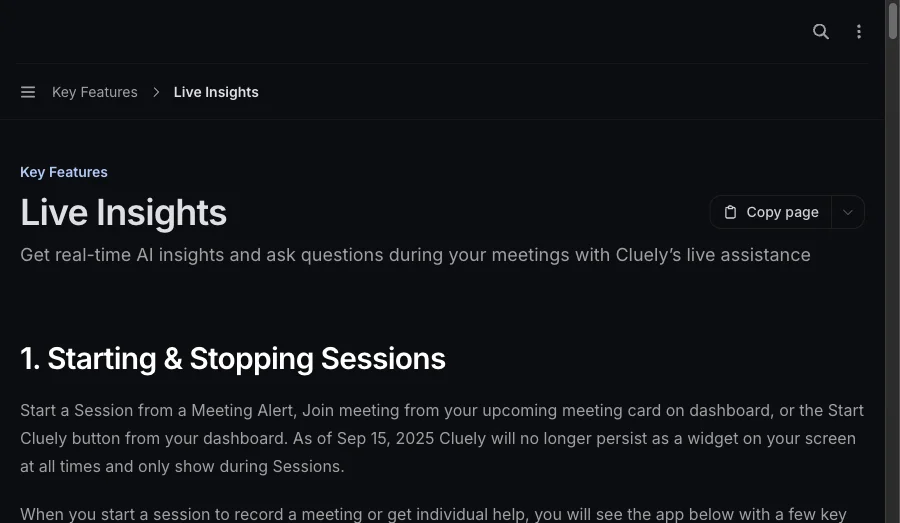
Public Cluely documentation captured November 25, 2026. It documents the interaction workflow, not measured answer quality. Open full-size.
Final Round AI starts with a Goal containing your resume, target role, job description and preparation materials. Its practice interview uses that context, and its automatic debrief is intended to carry feedback into the next attempt. The site names eight practice scenarios, including behavioral, coding, system design, product case and salary negotiation.
This is a practical advantage if your difficulty is knowing what to rehearse tomorrow. After a weak answer, a meeting recap might tell you what was discussed. A useful debrief should identify what made the answer weak and give you something to improve in the next round. Final Round explicitly documents that loop. Whether its feedback is specific enough for your experience remains a trial question.
Cluely gives you a meeting record and on-demand assistance across many kinds of calls. Final Round organizes preparation, assistance and review around a hiring goal. If you already practice with a colleague and maintain your own notes, the latter may duplicate work you are happy doing yourself.
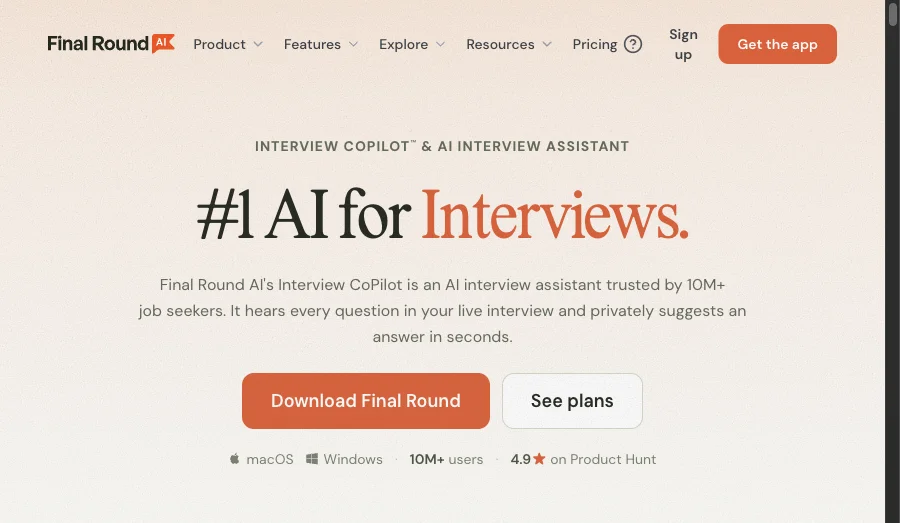
Final Round AI's public product page, captured November 25, 2026. This is a marketing-page screenshot, not a recording of a product trial. Open full-size.
User complaints that matter to this choice
I also read the public Cluely and Final Round AI Trustpilot pages. The examples below are dated user reports, not independently reproduced failures or estimates of how often problems occur. They identify practical checks that product descriptions cannot settle.
Cluely: transcript accuracy and subscription access
On March 26, 2026, Michael Chang reported incorrect words and speaker attribution in Cluely's transcription. On August 5, Sophia Piliouras described a paid subscription not appearing correctly in her account, which she said left features inaccessible and made billing support difficult. Both accounts appear on the Cluely review page.
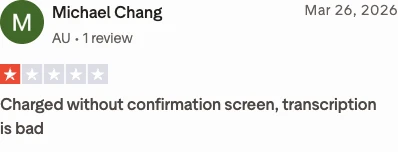
Michael Chang’s one-star Cluely review header, captured November 25, 2026. The original review discusses transcription and billing; the full account is linked below. This crop shows the rating and title, not the full review text.
Read the original review
.
For a live assistant, an incorrect technical term can change the question before an answer is generated. Check incoming audio with your normal headphones and verify the transcript before judging the answer. Separately, confirm that paid access appears in the account and retain billing and cancellation records. These reports concern the reviewers' particular setups and dates; they do not establish that every current Cluely session has those problems.
Final Round AI: keeping an answer readable as the conversation moves
In an October 8, 2026 review, Michael Amend Jr described the Windows live view moving to newer responses before he had finished reading the current one. Carlos E Bendfeldt, in an October 22 review, reported disputed renewal charges after cancellation. Both reports are on the Final Round AI review page.
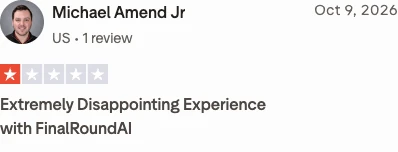
Michael Amend Jr’s one-star Final Round AI review header, captured November 25, 2026. Trustpilot displays October 9 in the browser’s local time; the publication timestamp is October 8 UTC. The full review describes response scrolling and support concerns. This crop shows the rating and title, not the full review text.
Read the original review
.
Those concerns affect different decisions: whether you can keep an answer readable, and whether the subscription suits your commitment. In a practice call, let the conversation continue while you use the current response. Before paying, check renewal and cancellation terms and retain confirmation.
The same page also includes an important correction: Daniel Rosu's July 2 update says a support-tool error was acknowledged and his refund was received. A complaint that was later resolved should not be presented as permanently unresolved. None of these accounts establishes that SkillCopilotAI is faster or more reliable; our own workflow needs the same practical checks.
A spoken answer that has to survive a technical follow-up
The following is an editor-created practice scenario, not a reported company interview and not output from any assistant. I use it because the first question is easy to answer fluently while still missing the problem.
Suppose your background note says:
I worked on the payment webhook consumer. I added duplicate-event handling and helped investigate discrepancies. Another team owned checkout and the payment provider integration.
The interviewer asks:
Our provider retries webhook notifications after a timeout. How did you stop retries from inflating payment totals?
A weak but plausible response is: “I designed a scalable payment architecture with robust retry mechanisms and ensured every order was processed exactly once.” It asserts ownership the note does not support. It also uses “exactly once” without explaining what happens if the consumer crashes between writing the payment and acknowledging the event.
A more defensible answer would stay within the stated responsibility:
I worked on the consumer. We needed to distinguish a repeated notification from a new payment event. I used the provider's event identifier to recognize retries, and the processing record had to be committed with the business change so that a crash could not apply the same event twice. I checked repeated notifications against the expected total. I would confirm the provider's identifier and delivery guarantees before choosing the storage constraint.
This is still an editorial reference answer. A real candidate should replace assumptions with the design they actually implemented. Its value is that it gives the interviewer something concrete to inspect: the deduplication key, the write boundary and the failure case.
Now change the question:
What if the same order has two legitimate captures, and a later partial refund?
An answer that continues to say “deduplicate by order ID” is now wrong. Two captures can belong to the same order while being different financial events. A refund is another event, not a retry of the capture. The assistant needs to update its reasoning rather than paraphrase the first answer more confidently.
For Cluely, the documented controls let you request help around the transcript, dynamic question or a typed follow-up. For Final Round, the documented route is contextual interview guidance within the saved Goal. Either product would need to distinguish the new condition in its actual output. An interview-specific label does not prove it does so, and a general meeting label does not prove it cannot.
This is also where response length affects usefulness. A long explanation may contain the right idea but leave you searching while someone waits. A compact editorial outline could be:
- Event ID identifies the notification; order ID identifies the business object.
- New capture or refund means a new event, even on the same order.
- Persist deduplication and the financial change together; explain the crash case.
Those cues support an answer. You still need to explain the transaction boundary and answer questions about the system you actually worked on.
Coding help: capture the input, then check the changed requirement
Some comparisons describe Cluely as unable to work with coding problems on screen. Its own Live Insights guide lists Get Answer for screen content and Smart Mode for coding assistance. Final Round documents Screen Help, with Auto-capture and an on-demand Solve screen action. The supported conclusion is that both describe visual input; the completeness and correctness of the resulting solution are unmeasured here.
Continue the practice example with a small event list. Amounts are integer cents, and each row is (event_id, kind, amount). For this exercise, event IDs are globally unique, amounts are nonnegative, repeated IDs must have identical payloads, and we calculate net captured value from the supplied events.
("evt_1", "capture", 10000)
("evt_1", "capture", 10000)  # retry
("evt_2", "capture",  4000)  # a separate capture
("evt_3", "refund",   1500)
("evt_3", "refund",   1500)  # retry of refund
The expected result is 12,500 cents: 10,000 + 4,000 − 1,500. Adding every row with a sign gives 21,000, because it counts both retries. Keeping only one row per order would lose legitimate events. Deduplicating only captures would subtract the refund twice and produce 11,000.
Here is an editor-written reference implementation, independently checked below. It is not generated output from Cluely, Final Round AI or SkillCopilotAI.
def net_captured_cents(events):
    seen = {}
    total = 0

    for event_id, kind, amount in events:
        if kind not in ("capture", "refund"):
            raise ValueError("unsupported event kind")
        if type(amount) is not int or amount < 0:
            raise ValueError("amount must be nonnegative integer cents")

        payload = (kind, amount)
        if event_id in seen:
            if seen[event_id] != payload:
                raise ValueError("same event ID has conflicting payloads")
            continue

        seen[event_id] = payload
        total += amount if kind == "capture" else -amount

    return total
The change from the initial spoken problem is small in code but substantial in meaning. The deduplication map stores the payload, not just the identifier, so a repeated ID carrying a different amount is flagged rather than silently discarded. Refunds use the same duplicate check as captures. Integer cents avoid introducing floating-point rounding into this simplified exercise.
The implementation uses expected O(n) time and O(u) additional space, where u is the number of unique event IDs. It is an in-memory reference, not a production payment consumer. It does not authenticate webhooks, persist deduplication across restarts, handle multiple currencies, or atomically update a ledger. A negative total is possible if the supplied events contain refunds without their earlier captures; the exercise does not silently turn that into zero.
What I checked in the reference code
I executed the article's implementation against the listed example and boundary cases: empty input, repeated captures, repeated refunds, a separate capture on the same conceptual order, conflicting payloads, unsupported event kinds and invalid amounts. The example returns 12,500 cents. A sequence check also confirms that reordering these independent events does not change the total.
For an assistant evaluation, keep the input and the expected values fixed before looking at the answer. If a generated solution gives 21,000, ask it to identify which rows are retries. If it gives 11,000, check whether only captures were deduplicated. If it silently accepts a changed amount for evt_1, ask what evidence makes that conflict safe to ignore. The value of another response is whether it corrects the logic and explains the correction.
With Cluely, use the documented screen-content action and confirm the event list is included. With Final Round, use Screen Help and confirm the current screen is the one being read. With SkillCopilotAI, the published screenshot workflow is relevant to capturing the same prompt and requesting debugging or explanation support. Apply the same correctness checks to all three. A screenshot arriving successfully does not establish that the answer is correct.
After the session: what would you change before the next round?
A useful review of the payment example should identify the missed distinction: order identity versus event identity, or capture handling versus refund handling. “Improve technical depth” alone gives you little to practice. A more actionable next attempt is to explain the crash window and then implement the same deduplication rule for both event kinds.
Cluely's meeting notes and questions about past meetings can help recover what was said. If you already know how to evaluate your answers, that record may be enough. Final Round's automatic debrief is more explicitly aimed at identifying interview weaknesses and informing the next practice session. It is the stronger documented fit when you want the product to organize that feedback loop.
Neither a tidy recap nor an encouraging score demonstrates improvement. Return to the question without looking at the previous answer. If you can explain why an order ID is the wrong deduplication key, identify the crash case and adapt the implementation to refunds, the practice has produced something you can use. Whether either product's feedback helps you get there is still part of the pending matched trial.
Free access, plans and the cost of finding out
The Cluely pricing page inspected for this article lists a free Starter tier with limited AI responses, limited meeting notetaking, custom instructions and up to three files. Pro lists unlimited responses and notetaking, while Pro + Undetectability separately adds its screen-sharing concealment claim.
The paid dollar amounts did not render in the current page check. Earlier articles on our site contain historical prices, but I have not promoted those figures into a November 25 quote. Verify the selected desktop or mobile product, billing toggle, payment total and included features before subscribing. In particular, do not assume ordinary Pro includes everything advertised for the higher tier.
Final Round's subscription page rendered these USD offers in the current session:
| Plan | Displayed rate | Billing implication |
|---|---|---|
| Free | $0 | Preparation/setup; no free live CoPilot trial according to the current homepage |
| Monthly | $150/month | The short commitment has a substantially higher monthly rate |
| Quarterly | $83.33/month, billed quarterly | Roughly $250 per quarter; verify the exact checkout total |
| Yearly | $25/month, billed annually | Roughly $300 upfront for a year, not a $25 monthly payment |
The inspected cards list standard models on monthly and quarterly plans and premium models on yearly. A difference in the model allowance is not evidence of a measured speed or accuracy difference. Offers may vary with discounts and account state, so the checkout terms matter more than a comparison article's old screenshot.
The free-access distinction matters before you compare subscription prices. Cluely Starter lets you sample limited live assistance. Final Round's current homepage says live sessions need an active Pro subscription and that there is no free live trial. Its free Goal and preparation setup are useful, but they do not answer whether live responses work for you.
SkillCopilotAI offers a different evaluation opportunity: one continuous, shared 60-minute trial, with the conditions described earlier. That is enough to attempt a focused practice task, not a promise of unlimited free assistance or a successful interview. For a broader list, see our free AI interview assistant guide.
Screen sharing and setup: verify the actual arrangement
Cluely sells screen-sharing concealment as a separate tier; Final Round lists Stealth Mode with its paid live product. These are vendor claims about supported capture behavior. They are not permission to use assistance in a particular interview and do not establish universal invisibility.
Cluely's documentation includes a compatibility section dated September 2025 with device and meeting-app exceptions. That older text is a reason to verify the current setup, not a reliable list of every supported configuration today. Final Round currently lists macOS 14.4+ and Windows on its public site. Check the exact operating-system requirement, app version and meeting application before paying.
For permitted practice, use the same layout you expect to work with: call window, code editor and assistant. Check audio input, whether the full question is captured, which screen supplies context and whether you can read the guidance while continuing to speak. A desktop app having a supported platform name does not resolve a wrong microphone, wrong monitor or distracting panel placement.
Which one would I choose?
I would shortlist Cluely for someone who already has a preparation method and wants help across ordinary work calls as well as interview practice. Its on-demand interaction, notes and past-meeting questions fit that use. Before upgrading, I would use Starter to see whether selecting prompts and reading responses is comfortable in the actual workflow. I would not buy it on the assumption that a dedicated mock interviewer or interview debrief is included in the inspected offering.
I would shortlist Final Round AI for someone who wants repeated role-specific rehearsal and a connected review process. Its documented Goal, Practice Interview, Screen Help and Debrief form a more explicit interview preparation chain. The tradeoff is that the live feature requires payment before you can evaluate it through the free offering, and an annual-equivalent price requires a larger upfront commitment.
I would include SkillCopilotAI when the deciding task crosses spoken explanation and screenshot-based coding, and you want to attempt that task in a trial first. Prepare a short, accurate background note and the event example above before the clock starts. Judge the output by whether you can explain and verify it, using the same standard you would apply to the competitors.
For more product-specific detail, read our Cluely review, Final Round AI review and Cluely alternatives. Their dated pricing observations may differ from this check; use the current official plan and checkout for a purchase.
Frequently asked questions
Is Cluely or Final Round AI better for interview preparation?
Final Round AI is the more explicit documented fit for structured interview preparation because it connects role materials, spoken practice and an automatic debrief. Cluely is broader meeting assistance. Actual coaching quality and answer accuracy were not compared in a matched trial here.
Can Cluely help with a coding question on screen?
Its Live Insights documentation lists Get Answer for screen content and Smart Mode for coding assistance. That supports describing visual coding help as a documented capability. It does not establish correct code, supported behavior on every coding platform or reliable adaptation to a follow-up.
Are both products free to try?
Cluely Starter includes limited live responses and notes. Final Round offers free setup/preparation, but its current homepage says live CoPilot requires an active Pro subscription with no free live trial. A free account and a free live session are different things.
Is Final Round AI really $25 per month?
The inspected subscription page shows $25 per month billed annually, alongside a $150 monthly plan. The annual rate implies roughly $300 upfront. Confirm the exact total, renewal and any discount at checkout.
What should I use SkillCopilotAI's 60-minute trial for?
Use it for the part of your workflow you need to evaluate: supply your own context, attempt one spoken question, add its technical screen and change a requirement. Check facts, code and explanation. Prepare first because the trial starts at first authorization and continues while the app is closed; its minutes are shared across trial features, with limited models.
Share this article
Compare similar tools
Editor selected
Cluely AI Review 2026: Features, Pricing, Privacy, and Verdict
Is Cluely worth it? This research-based review examines its live meeting features, current pricing, privacy terms, limitations, and best-fit users.
Editor selected
Final Round AI Reviews: Trustpilot Ratings, Pricing, Refunds and Who It Fits (2026)
Final Round AI reviews checked on November 3, 2026: a 2.8/5 Trustpilot score from 280 reviews, two pricing layouts ($150 monthly or $125/mo every two months), the October 2026 refund policy, and who should pay.
Editor selected
Parakeet AI vs Cluely: Interview Tool or Meeting Assistant?
Parakeet AI vs Cluely compared on interview features, free access and the real cost of screen-share hiding, plus where SkillCopilotAI fits.
Same content type
LockedIn AI vs Parakeet AI: Which Workflow Fits Your Interview?
Compare LockedIn AI vs Parakeet AI on live-session limits, phone and desktop inputs, free trials, credits, current payments and user-reported problems.
Choose your next step
Compare another tool or move from research into structured interview practice.